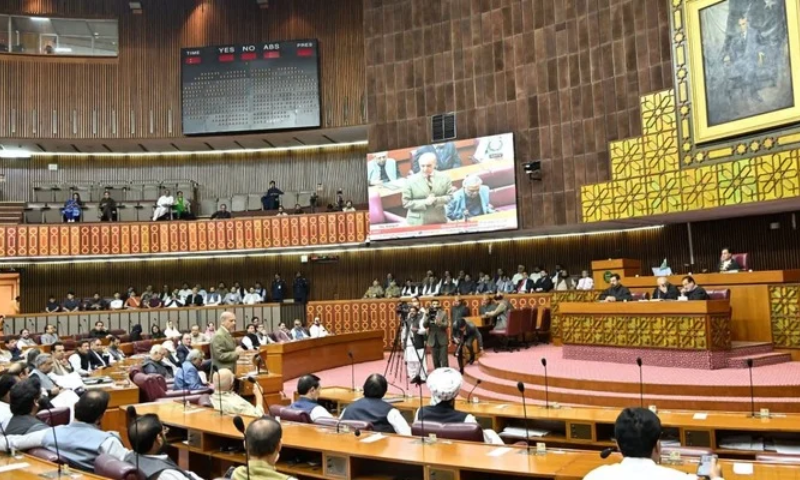
Islamabad, June 23, 2026: The National Assembly on Tuesday approved the Finance Bill 2026-27, formally adopting the federal budget for the upcoming fiscal year with significant changes to import duties on vehicles, stricter tax compliance measures, mandatory electronic filing requirements, and enhanced powers for the Federal Board of Revenue (FBR).
The budget, carrying a total outlay of Rs18.771 trillion, introduces a broad range of fiscal and taxation reforms aimed at expanding the tax base, improving revenue collection, digitising tax administration, and encouraging compliance through stricter enforcement mechanisms.
Under the approved Finance Bill, customs duties and taxes on imported vehicles have been substantially revised.
Imported vehicles with engine capacities between 2,000cc and 3,000cc will be subject to an 86 percent duty, while vehicles above 3,001cc will face a 92 percent duty from July 1.
At the same time, duties on several lower-engine-capacity vehicles have been significantly reduced. The duty on imported 1,800cc vehicles has been cut from 156 percent to 74 percent, while vehicles above 1,500cc will see duties reduced from 91 percent to 57 percent.
Similarly, imported vehicles ranging from 1,000cc to 1,500cc will attract a reduced duty rate of 52 percent, down from 76 percent, while duties on 850cc vehicles have been lowered from 66 percent to 42 percent.
The government has also decided not to impose a special excise duty on vehicles up to 1,800cc under the new auto policy.
The Finance Bill introduces a revised customs duty regime for imported electric vehicles (EVs).
Large EVs valued at up to $75,000 will be subject to a 30 percent customs duty, while EVs valued above $110,000 will face a 40 percent duty.
The measure is part of the government’s broader effort to rationalise taxation on imported vehicles while encouraging local manufacturing and assembly.
In a move aimed at easing costs for students and families, the government has approved a concessional 10 percent sales tax on children’s educational stationery, including pencils, pens and sharpeners.
The budget also introduces a revised token tax structure for vehicles registered within the federal jurisdiction.
A one-time fixed tax of Rs10,000 will be imposed on vehicles up to 1,000cc from July 1, while pre-2010 vehicles in the same category will be charged a token tax of Rs20,000.
Vehicles ranging from 1,001cc to 1,300cc will be taxed at 0.3 percent of the total invoice value, while a separate federal token tax has been fixed at 0.25 percent of the vehicle’s invoice value.
For other categories, pre-2010 vehicles will be charged a token tax of Rs2,500, whereas post-2010 models will pay Rs6,200, compared to the previous rate of Rs1,500.
One of the most significant features of the Finance Bill is the tightening of tax compliance laws and enforcement powers.
The National Assembly approved amendments to Section 182 of the Income Tax Ordinance, 2001, under which taxpayers may be subjected either to the applicable tax on taxable income or the highest tax liability recorded during the previous three years.
The government has also introduced harsher penalties for non-compliance with FBR notices.
Under the new provisions, failure to comply with an FBR notice for the first time will attract a fine of Rs1 million, while repeated violations may result in penalties of up to Rs2 million.
From July 1, businesses required to install the FBR’s electronic tax monitoring system will face strict penalties for non-compliance.
According to the Finance Bill, failure to install the system within the prescribed timeframe, disrupting its operation, or deliberately rendering it non-functional may lead to severe legal consequences.
Those found interfering with the electronic monitoring system could face imprisonment of up to five years, in addition to financial penalties.
Factories, industrial units and commercial establishments damaging or tampering with the monitoring infrastructure may also face prosecution.
The first violation related to the electronic system will result in a Rs1 million fine, while each subsequent violation will attract an additional Rs1 million penalty.
To encourage adoption, the FBR will offer rebates of up to Rs30 million to eligible taxpayers installing the electronic monitoring system.
Detailed procedures for installation and enforcement are expected to be published on the FBR website on July 1.
The Finance Bill mandates a complete transition to electronic tax filing beginning July 1.
Income tax returns will now be submitted exclusively through the IRIS online portal, eliminating manual filing procedures.
Corporate entities will also be required to submit financial statements in machine-readable formats, further advancing the government’s digital taxation agenda.
The legislation additionally introduces an algorithmic settlement mechanism, allowing taxpayers to submit revised returns without prior approval from the commissioner.
Taxpayers opting for this mechanism will not face separate penalties or surcharges, a move aimed at simplifying compliance and reducing administrative delays.
Prime Minister highlights Pakistan’s diplomatic role
Speaking in the National Assembly following the passage of the budget, Prime Minister Shehbaz Sharif highlighted Pakistan’s recent diplomatic efforts in facilitating dialogue between Iran and the United States.
The Prime Minister informed lawmakers that an agreement had recently been signed between Tehran and Washington under the Islamabad Memorandum of Understanding (MoU), adding that Pakistan had made sincere efforts to bridge differences between the two sides.
He expressed optimism that ongoing technical-level negotiations over the next 60 days would help transform the current ceasefire into a durable and lasting peace arrangement.
Congratulating parliament and the nation, Prime Minister Shehbaz said Pakistan had played a historic role in advancing regional stability and peace.
He also welcomed the arrival of Iranian President Dr. Masoud Pezeshkian in Islamabad, urging political leaders to set aside differences and extend a warm reception to the visiting dignitary.
Addressing domestic political issues, the Prime Minister reiterated that Pakistan’s progress could not be measured through the development of any single province alone and stressed the importance of balanced growth across all four provinces.
Key budget allocations and economic targets
Earlier this month, Finance Minister Muhammad Aurangzeb presented the federal budget for fiscal year 2026-27 with a total size of Rs18.771 trillion.
The largest allocation of Rs8.054 trillion has been earmarked for debt servicing and mark-up payments, followed by Rs3 trillion for defence expenditure.
The federal government’s Public Sector Development Programme (PSDP) has been allocated Rs1 trillion.
For the upcoming fiscal year, the government has set an economic growth target of 4 percent, while average inflation is projected at 8.2 percent.
Officials say the budget seeks to balance fiscal consolidation with economic growth objectives through enhanced revenue generation, improved tax administration and targeted incentives for businesses and consumers.