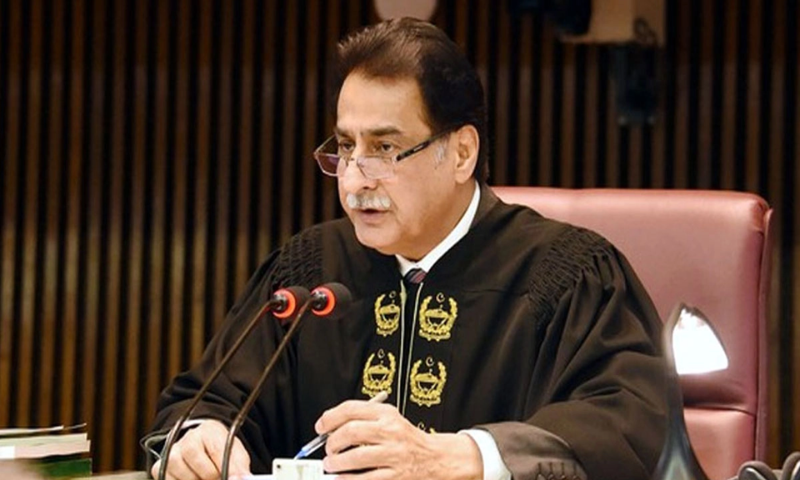
Islamabad, June 24, 2026: Speaker of the National Assembly, Sardar Ayaz Sadiq, on Wednesday reaffirmed his commitment to upholding the Constitution, parliamentary traditions, and democratic values while responding to remarks made by the Leader of the Opposition during the ongoing Budget Session 2026-27.
Addressing the House, the Speaker stated that he had resigned from the Pakistan Tehreek-e-Insaf (PTI) in 1998 and still possessed the resignation letter, which outlined his reasons for leaving the party. He said the letter reflected concerns regarding the treatment of party members and individuals within the organization at that time.
Ayaz Sadiq informed lawmakers that he joined the Pakistan Muslim League-Nawaz (PML-N) on February 1, 2001, when former Prime Minister Nawaz Sharif had been in exile for only 50 days. He emphasized that he had not joined a ruling party but rather a political party whose leadership was expected to remain outside the country for an extended period.
Clarifying his earlier remarks regarding Shah Mahmood Qureshi, the Speaker said his comments had been taken out of context and misrepresented. He maintained that his observations were specifically related to Qureshi and stood by the statement he had made.
Responding to personal remarks directed at him during parliamentary proceedings, Ayaz Sadiq noted that he had been referred to as a “Havaldar.” In a light-hearted response, he said he knew of two kinds of Havaldars: those who defend the country’s borders with courage and sacrifice, and those who protect society by apprehending criminals and drug traffickers. He added that while the comment was aimed at him personally, he chose to respond with restraint and dignity.
The Speaker stressed that although constitutional provisions provide protection to the office of the Speaker within parliamentary parameters, he had never attempted to prevent members from expressing their views. He said he remained open to constructive criticism that contributes to strengthening parliamentary institutions.
Referring to allegations that he had violated the Constitution, Ayaz Sadiq said he repeatedly asked critics to identify the specific constitutional provision that had allegedly been breached but received no response before the Leader of the Opposition left the House. He urged all members to observe parliamentary norms and maintain mutual respect.
“Every member of the House deserves respect,” he said, adding that political offices are temporary, while relationships built on dignity and mutual regard should endure beyond political differences. He emphasized that political disagreements should focus on issues and policies rather than personal animosity.
The Speaker reiterated that all his rulings and decisions were guided strictly by the Constitution of Pakistan and the Rules of Procedure and Conduct of Business in the National Assembly, 2007. While acknowledging that no individual is infallible, he said he remained committed to fairness, impartiality, and avoiding unnecessary offence to any member.
Highlighting the conduct of the Budget Session 2026-27, Ayaz Sadiq said the opposition had been provided nearly twice the time originally allocated for participation in the budget debate. According to the Speaker, 67 opposition lawmakers took part in the discussions, and efforts were made over three consecutive days to encourage all opposition members to attend and contribute.
He further revealed that security officials had been instructed to personally contact opposition lawmakers who had not yet spoken and invite them to participate in the proceedings. Despite these efforts, several members did not attend, he said.
The Speaker also noted that while debates on cut motions typically involve between five and ten members, the Chair allowed up to 25 opposition lawmakers to speak in order to maximize participation. He expressed regret that despite these opportunities, some opposition members later claimed in media interactions that they had not been given adequate time to speak.
Concluding his remarks, Ayaz Sadiq reaffirmed his commitment to ensuring equal opportunities for all members and preserving the dignity, impartiality, and effectiveness of Parliament.