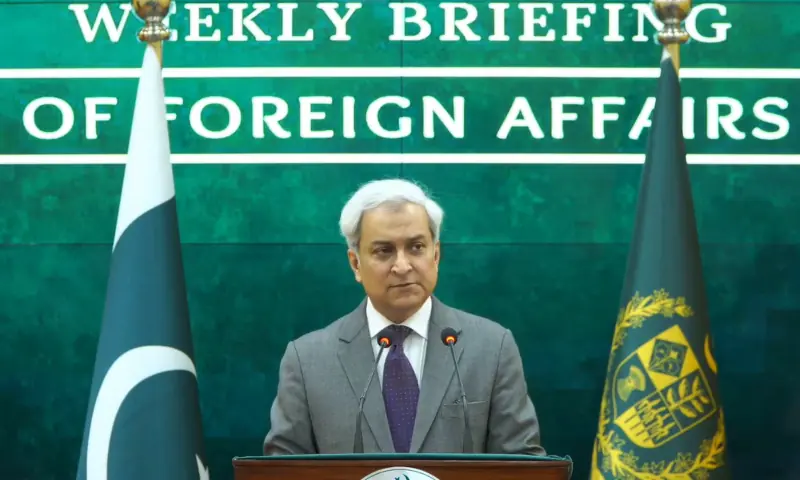
Islamabad, July 2, 2026: Prime Minister Shehbaz Sharif will undertake official visits to Iran and Turkiye from July 3 to July 5, Foreign Office spokesperson Tahir Andrabi announced on Thursday, saying the trip would focus on condolence diplomacy in Tehran and bilateral cooperation with Ankara.
Speaking at the weekly media briefing, Andrabi said the prime minister would first travel to Iran to attend the funeral of former Iranian Supreme Leader Ayatollah Ali Khamenei, who was assassinated in US-Israeli strikes on February 28. Deputy Prime Minister and Foreign Minister Ishaq Dar, along with cabinet members and senior officials, will accompany him.
“The prime minister will convey condolences on behalf of the people and government of Pakistan to the Iranian leadership and the bereaved families while reaffirming solidarity with the brotherly nation in their hour of profound grief,” the spokesperson said.
Following the Iran visit, Prime Minister Shehbaz will travel to Istanbul at the invitation of Turkish President Recep Tayyip Erdogan. According to the Foreign Office, the two sides will hold talks on the full spectrum of bilateral relations, with particular emphasis on enhancing trade and investment cooperation.
Andrabi said the leadership-level engagement would also include discussions on regional peace and security. During the visit, the prime minister is also expected to address a business conference hosted by Pakistan to showcase the country’s trade and investment potential in key sectors, including special economic zones, energy, trade, information technology and privatisation.
The spokesperson said the conference would bring together leading Turkish businessmen, investors, senior officials and members of the wider business community.
He said the prime minister’s visits to Iran and Turkiye reflected Pakistan’s “deep-rooted, historic, cultural and fraternal ties” with the two countries.
Pakistan to continue facilitative role in US-Iran dialogue
Briefing the media on the US-Iran conflict and subsequent diplomatic efforts, Andrabi said Pakistan had stepped up engagement with regional and international stakeholders, as well as the principal interlocutors, to support implementation of the Islamabad Memorandum of Understanding signed between Washington and Tehran on June 18.
Under the 14-point accord, the two sides agreed on a framework to end the war, reopen the Strait of Hormuz and negotiate on key issues within 60 days of signing the agreement.
Andrabi said “positive progress” had been made on various aspects of the Islamabad MoU during the latest round of US-Iran talks in Doha, which continued into Wednesday morning. He reiterated that Pakistan, in coordination with Qatar, would continue to play a facilitative and mediatory role in the negotiation process.
He added that Deputy Prime Minister Ishaq Dar had also remained engaged in high-level consultations with several foreign counterparts in recent days.
India cannot use water as a political tool
During the briefing, the Foreign Office also strongly criticised India’s handling of the Indus Waters Treaty (IWT), rejecting what Andrabi described as New Delhi’s attempt to use “baseless allegations of terrorism” as a pretext to place the treaty in abeyance and obstruct Pakistan’s lawful share of river waters.
He said the real issue was India’s growing tendency to treat a shared international river system as a strategic asset that could be controlled, withheld or diverted at will.
“This mindset of unilateral appropriation is fundamentally incompatible with the letter and spirit not only of international law but also of the Indus Waters Treaty,” he said, adding that water was not a tool of coercion or political pressure.
Andrabi warned that any attempt to deny Pakistan its legitimate share of Indus waters would amount to a clear violation of India’s international legal obligations and would undermine its credibility in treaty-based relations.
Referring to the international seminar on the Indus Waters Treaty held in Islamabad earlier this week, the spokesperson said participants had called for upholding the treaty and rejecting the weaponisation of water. He said speakers, including Deputy Prime Minister Ishaq Dar and international scholars, had stressed that disputes should be resolved through legal and diplomatic channels rather than unilateral actions.
When asked whether Pakistan could be turned into “barren land” through water pressure, Andrabi dismissed the notion, saying no country had the power to do so.
Responding to a question about a recent civil society letter addressed to the Pakistani and Indian prime ministers urging steps to restore peace and dialogue, Andrabi said private individuals were free to write such letters, but the government and the Foreign Office neither endorsed nor rejected the initiative.
The letter was reportedly signed by several prominent figures from both Pakistan and India, including former ambassador Ashraf Jehangir Qazi and politician Farhatullah Babar from Pakistan.
Pakistan’s prisoner list ‘authentic and meticulously compiled’
On the exchange of prisoner lists between Pakistan and India, Andrabi said Pakistan had shared a list of 753 Pakistani prisoners believed to be in Indian custody, which he described as “meticulously compiled” and authentic.
He said India, by contrast, had shared a list of 439 prisoners who were “Pakistani or believed to be Pakistani”. Pakistan’s list, he added, included all reported cases of Pakistani nationals detained in India, drawing on newspaper reports, family notifications and information received through official channels.
Unauthorised work at Farooqabad gurdwara halted, says FO
Responding to Indian criticism over the reported demolition of a gurdwara in Punjab’s Farooqabad, Andrabi said the structure in question had not been in religious use and was in a dilapidated condition that posed a safety risk.
He clarified that the action had been initiated by tenants without the permission of the Evacuee Trust Property Board (ETPB), after which the unauthorised work was halted on June 24 and the tenancy was cancelled.
According to the spokesperson, the building had seven sections, and the tenants had begun work on two of them as a “preventive measure” amid fears that the old structure could collapse during the rainy season.
He said immediate remedial action had been taken and that the authorities would ensure the building remained intact, with renovation work also being considered. Andrabi added that there was no Sikh community in the vicinity using the site for religious purposes and that the property had been under private tenancy.