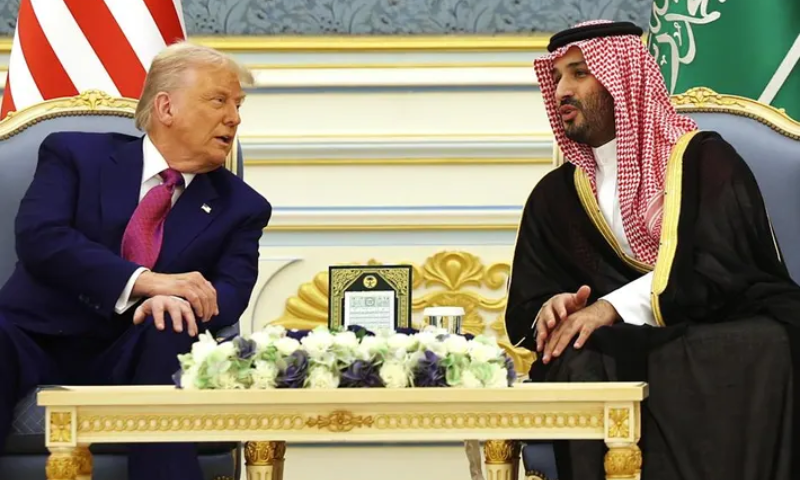
Washington, July 23, 2026: U.S. President Donald Trump on Thursday said a landmark agreement to support Saudi Arabia’s civilian nuclear programme would only move forward if the Kingdom joins the Abraham Accords and normalizes diplomatic relations with Israel.
In a post on his Truth Social platform, Trump said the proposed agreement was strictly limited to the peaceful use of nuclear technology, similar to civilian nuclear programmes already operating in countries such as the United Arab Emirates and Iran.
“The deal will be approved, but is totally subject to Saudi Arabia joining the very respected and successful Abraham Accords,” Trump said.
The Abraham Accords, brokered during Trump’s first presidency in 2020, normalized relations between Israel and several Arab states. However, the agreements remain controversial across much of the Middle East because they do not address the longstanding Israeli-Palestinian conflict.
The announcement comes amid heightened regional tensions and continued international concern over nuclear proliferation following the recent conflict involving the United States and Iran, which was largely driven by disputes surrounding Tehran’s nuclear programme.
According to the U.S. Department of Energy, Energy Secretary Chris Wright and Saudi Energy Minister Prince Abdulaziz bin Salman signed two agreements covering peaceful nuclear cooperation and bilateral safeguards. The department said the agreements establish the legal framework for a decades-long, multi-billion-dollar partnership aimed at advancing civilian nuclear energy while maintaining nuclear non-proliferation commitments.
The text of the agreements has not yet been made public.
The department said the partnership would support several strategic and economic objectives, including strengthening nuclear safety standards and expanding cooperation in civilian nuclear technology.
Media reports suggested the agreement could allow U.S. companies to construct a uranium enrichment facility in Saudi Arabia, although the Energy Department neither confirmed nor commented on the reported provision.
The agreement will now be submitted to the U.S. Congress for review. While the Republican-controlled Congress is not expected to block the deal, lawmakers from both major parties, as well as Israeli officials, have previously expressed concerns that uranium enrichment capabilities could eventually be diverted for military purposes.
Saudi Arabia has consistently maintained that it seeks nuclear technology solely for peaceful energy purposes and has repeatedly asserted its right to develop a civilian nuclear programme.
Washington has long sought to integrate nuclear cooperation with a broader strategic framework that includes Saudi recognition of Israel and closer U.S.-Saudi security cooperation. A proposed defence pact between Washington and Riyadh has also featured prominently in previous negotiations.
Pakistan and Saudi Arabia strengthened their strategic ties by signing a mutual defence agreement in September 2025.
The proposed agreement has also renewed debate among non-proliferation experts. While U.S. Energy Secretary Chris Wright dismissed concerns, saying the deal upholds the highest standards of nuclear safety and non-proliferation, some analysts cautioned against allowing uranium enrichment on Saudi territory.
Matthew Kroenig of the Atlantic Council argued that although strengthening relations with Saudi Arabia serves U.S. strategic interests, permitting domestic uranium enrichment could weaken longstanding global non-proliferation standards.
Others viewed the agreement as strategically important. Jennifer T. Gordon, Director of the Atlantic Council’s Nuclear Energy Policy Initiative, described the deal as a significant geopolitical success for Washington, saying it would help ensure Saudi Arabia partners with the United States rather than Russia or China in developing its civilian nuclear energy sector.