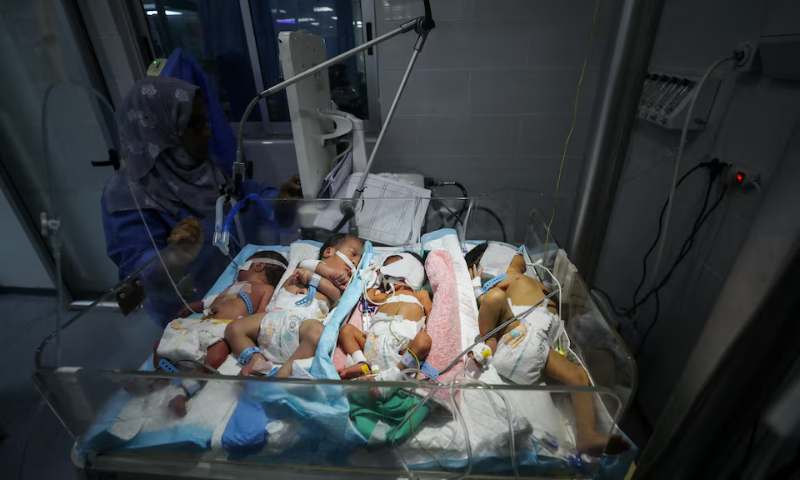
Gaza City, July 10, 2025: Doctors in Gaza are warning of an impending medical catastrophe as fuel shortages cripple hospitals across the war-torn enclave, forcing them to place multiple premature babies into single incubators in a desperate attempt to keep them alive.
At Al Shifa Medical Center, Gaza’s largest hospital, doctors say they are struggling to provide basic care amid a devastating lack of fuel, medicine, and power, as Israel continues its 21-month military campaign against Hamas.
“We are forced to place four, five, or sometimes three premature babies in one incubator,” said Dr. Mohammed Abu Selmia, Al Shifa’s director. “Premature babies are now in a very critical condition.”
Dr. Muneer Alboursh, director general of Gaza’s Ministry of Health, said the threat to life is no longer coming from missiles but from a “siege choking the entry of fuel,” which he said is turning hospitals into “silent graveyards.”
An Israeli military official said that roughly 160,000 litres of fuel have entered Gaza for humanitarian purposes since Wednesday, but that Israel has no control over its internal distribution. U.N. agencies operating in Gaza are responsible for deciding where the fuel goes, he said.
It remains unclear whether any of the fuel has reached Al Shifa, which is now rationing electricity by shutting down departments—including its dialysis unit—to preserve power for intensive care and operating rooms.
“Oxygen stations will stop. Blood banks will spoil. A hospital without oxygen is no longer a hospital,” said Abu Selmia. “If fuel doesn’t arrive, Al Shifa could turn into a graveyard for those inside.”
The World Health Organization (WHO) has documented more than 600 attacks on healthcare facilities since the war began. Only 18 of Gaza’s 36 general hospitals remain even partially functional, according to the U.N.
Conditions are dire at other facilities as well. At Nasser Medical Complex in Khan Younis, spokesperson Mohammed Sakr said the hospital has only 3,000 litres of fuel left, far below its daily requirement of 4,500 litres.
“We are conducting surgeries without electricity or air conditioning. Sweat is dripping from the surgeons into the patients’ wounds,” he said.
There are reportedly around 100 premature babies at risk in Gaza City hospitals. Before the war, there were 110 incubators in northern Gaza; now fewer than 40 remain in use, according to hospital officials.
The fuel crisis comes amid renewed controversy over the delivery of humanitarian aid. Earlier this year, Israel imposed a complete blockade on Gaza, only partially lifting it under a U.S. and Israeli-backed scheme that largely bypasses the U.N. system. Israel accuses Hamas of diverting aid—an allegation Hamas denies.
COGAT, the Israeli military’s aid coordination agency, did not immediately respond to requests for comment about the situation in Gaza’s hospitals.
UNICEF spokesperson James Elder, recently returned from Gaza, said, “You can have the best hospital staff on the planet, but if they are denied medicines, painkillers, and now the very means to power their work, it becomes an impossibility.”
Since the war began in October 2023—following a Hamas-led attack that killed 1,200 Israelis and saw 251 hostages taken—Gaza’s Health Ministry says over 57,000 Palestinians have been killed in the conflict. The war has displaced nearly the entire population, pushed Gaza into famine-like conditions, and sparked international accusations of war crimes and genocide, which Israel denies.