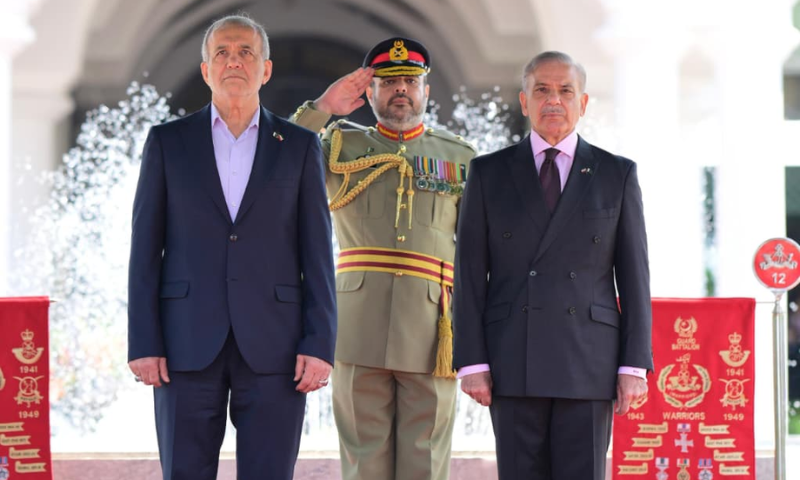
Islamabad, August 3, 2025: Prime Minister Shehbaz Sharif on Sunday reaffirmed Pakistan’s support for Iran’s right to peaceful nuclear energy, stating that Islamabad stands firmly with Tehran on this critical issue.
“Pakistan fully supports Iran’s pursuit of nuclear technology for peaceful purposes,” said PM Shehbaz during a joint press conference with Iranian President Masoud Pezeshkian, who is currently on his first official two-day visit to Pakistan.
The statement comes amid heightened global scrutiny of Iran’s nuclear programme, which has become a flashpoint in its recent conflict with Israel. The tensions escalated further after the United States launched strikes on several Iranian nuclear facilities.
With the end of August marked as a de facto deadline by the U.S., France, Germany, and the UK to reach a new nuclear agreement, Iran has resumed direct and “frank” discussions with European nations. The International Atomic Energy Agency (IAEA) has welcomed these developments, expressing hope for renewed inspections of Iranian nuclear sites.
The 2015 nuclear deal—abandoned by the U.S. in 2018—continues to shape diplomatic efforts. The agreement had offered sanction relief in exchange for curbs on Iran’s nuclear activities. A crucial October 18 deadline looms, when the deal’s governing UN resolution is set to expire. Unless a “snapback” mechanism is triggered within 30 days prior, all UN sanctions on Iran will be lifted.
Highlighting the economic dimension of the visit, PM Shehbaz revealed that Pakistan and Iran have set a trade target of $10 billion. He said both sides held wide-ranging discussions on bilateral ties, regional issues, and cross-border cooperation.
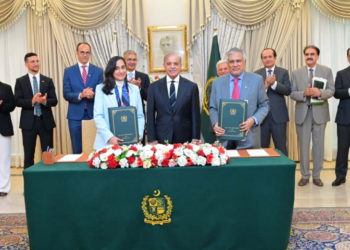
“Today, we signed several Memorandums of Understanding (MoUs) which I am confident will soon translate into formal agreements,” he said.
Condemning Israel’s recent attacks on Iran, PM Shehbaz offered prayers for those martyred and praised Tehran’s unwavering support for the Palestinian cause. He also drew parallels with the situation in Indian Illegally Occupied Jammu and Kashmir (IIOJK), urging the global community to speak out against atrocities in Gaza.
“The world must unite for peace in Gaza,” the Prime Minister emphasized.
President Pezeshkian expressed gratitude for Pakistan’s warm welcome, calling it his “second home.” He thanked Islamabad for its stance against Israeli aggression and highlighted the importance of Muslim unity in facing shared challenges.
Speaking on bilateral relations, President Pezeshkian said: “Iran and Pakistan share deep cultural and religious ties. Strengthening these relations is a cornerstone of our foreign policy.”
He underscored Tehran’s commitment to enhancing cooperation with Islamabad across political, economic, and cultural domains. The two nations, he added, are also working together to improve border security.
Earlier, the two countries signed 12 agreements and MoUs covering a range of cooperation areas, according to Radio Pakistan. These include:
- Plant protection and quarantine
- Joint use of the Mirjaveh-Taftan border crossing
- Science, technology, and innovation collaboration
- ICT cooperation
- Cultural, tourism, youth, and media exchanges
- Meteorology and disaster-related collaboration
- Maritime safety and firefighting
- Judicial assistance in criminal matters
- Aviation agreements
- Mutual recognition of certification and product testing
- Tourism cooperation (2025–2027)
- A joint ministerial declaration on advancing a Free Trade Agreement
On the sidelines of the visit, Federal Commerce Minister Jam Kamal Khan met with Iranian Minister for Industry, Mines and Trade, Mohammad Atabak. Both reaffirmed their commitment to strengthening economic ties by removing trade barriers and expanding cooperation across key sectors.
Jam Kamal proposed regular B2B interactions, targeted trade missions, and deeper institutional collaboration through the Joint Economic Commission (JEC). He identified agriculture, livestock, energy, and cross-border logistics as priority areas for future cooperation.
Atabak endorsed the idea of holding dedicated B2B events during high-level visits and expressed readiness to bring Iranian business delegations to Pakistan.
“Business communities on both sides are eager and ready. What’s needed now is consistent and clear facilitation from our governments,” Atabak stated.