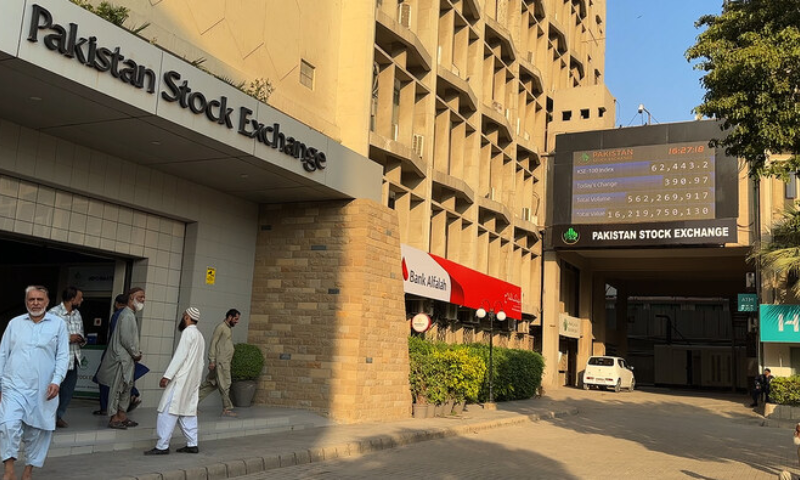
Karachi, January 5, 2026: The Pakistan Stock Exchange (PSX) continued its strong start to 2026 on Monday, with the benchmark KSE-100 Index rising 3,373.3 points, or 1.88%, to close at 182,408.23, extending gains from the first three sessions of the year. The index touched an all-time intraday high of 183,964.37, marking a gain of 4,929.44 points, or 2.75%, from the previous close of 179,034.93.
“The year has started on a positive note as investors pour massive liquidity into asset allocation,” said AAH Soomro, an independent investment and economic analyst, while cautioning that markets may be moving “too fast too soon.”
Research houses remain optimistic. AKD Research highlighted the potential for stronger sentiment driven by foreign portfolio and direct investment inflows, projecting the KSE-100 Index could rise toward 263,800 by December 2026. Key supporting factors include easing monetary conditions, improving external accounts, and ongoing economic reforms.
The market’s momentum follows a record 6,634-point (3.8%) weekly gain last week, supported by a softer-than-expected December 2025 Consumer Price Index (CPI) of 5.6%, raising expectations of further monetary easing. On Friday, the benchmark had climbed 2,679.44 points (1.52%) to 179,034.93.
Economic indicators show mixed signals. Pakistan’s trade deficit widened 24% year-on-year to $3.7 billion in December 2025, while GDP growth recorded 3.7% YoY in 1QFY26. State Bank of Pakistan (SBP) foreign-exchange reserves rose $13 million week-on-week to $15.9 billion as of December 26, with the rupee appreciating 0.02% to 280.11 per US dollar.
The SBP purchased $6.9 billion from the currency market over the past 12 months, and the Federal Board of Revenue (FBR) collected Rs6.2 trillion in 1HFY26, missing its target by Rs338 billion. Authorities are also exploring a $1 billion liability settlement via UAE investment in Fauji Group, while the US has signaled renewed interest in partnerships in locomotive sales and mineral exploration. Pakistan is also planning its first Panda bond issuance in China.
Weekly inflation, measured by the Sensitive Price Indicator (SPI), fell 0.67% in the week ending January 1, 2026, to 333.96 from 336.22, while on a year-on-year basis, SPI rose 2.41%, according to the Pakistan Bureau of Statistics. The SPI declined across all consumption brackets, with the lowest band (up to Rs17,732) falling 0.62% and higher bands decreasing 0.61%–0.73%.
The strong equity rally reflects investor optimism fueled by easing inflation, expectations of continued monetary support, and positive economic indicators, setting the tone for a potentially bullish year ahead for Pakistan’s stock market.