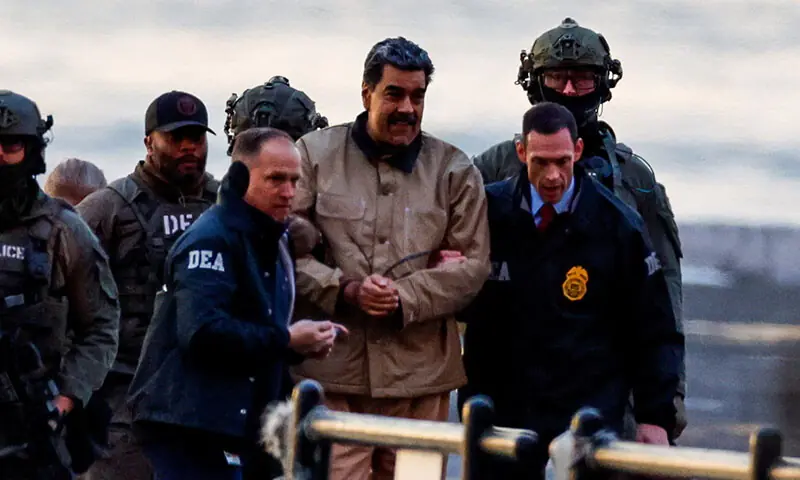
New York/Caracas, January 5, 2026: Venezuelan President Nicolas Maduro arrived at a New York courthouse on Monday, days after being captured in a dramatic US military operation in Caracas that has set the stage for Washington’s plans to assert control over the oil-rich nation.
Maduro, 63, along with his wife, Cilia Flores, faces narcotrafficking charges. The pair were seized in a US assault on Saturday involving helicopters, fighter jets, and naval forces. On Monday, Maduro was escorted to court by heavily armed law enforcement officers after being transported via helicopter and armored vehicle.
The situation has sparked widespread tension in Venezuela. Some 2,000 Maduro supporters, including armed men on motorcycles, rallied in Caracas over the weekend. Meanwhile, the Venezuelan military, largely loyal to Maduro, recognized interim leader Delcy Rodriguez and called for calm. Rodriguez has indicated willingness to work with the US administration, saying, “We extend an invitation to the US government to work together on an agenda for cooperation.”
The US government has emphasized its control over the South American nation following the operation. President Donald Trump stated that Washington is “in charge” of Venezuela and stressed the need for “total access” to the country’s oil and other resources. Secretary of State Marco Rubio warned that discussions on elections under the new interim leadership are “premature.”
Venezuela, home to the world’s largest proven oil reserves, could see increased crude in global markets, though analysts caution that boosting production will not be easy or immediate. Oil prices dipped as investors weighed the potential impact. The US retains economic leverage through a blockade on Venezuelan oil tankers, while a large naval presence, including an aircraft carrier, remains off Venezuela’s coast
The US operation reportedly resulted in significant casualties. Venezuela’s Defence Minister Vladimir Padrino Lopez stated that a “large part” of Maduro’s security team, along with military personnel and civilians, were killed. Cuba reported 32 Cuban nationals were among the dead.
International reactions have been swift. China, Russia, and Iran condemned the US action and called for Maduro’s release, with China calling the operation a “clear violation of international law.” Colombian President Gustavo Petro criticized the US intervention as “an assault on the sovereignty of Latin America” and warned it could trigger a humanitarian crisis.
Despite Maduro’s capture, key allies and figures from his government remain influential, including Flores, Rodriguez, her brother Jorge, and Interior Minister Diosdado Cabello. US officials have indicated that the goal is Maduro’s removal and a compliant interim government, rather than a complete regime change.
The UN Security Council is scheduled to hold an emergency session on Monday at Venezuela’s request. Meanwhile, Maduro’s allies and supporters in Venezuela continue to call for his release, highlighting the ongoing volatility and uncertainty in the region.