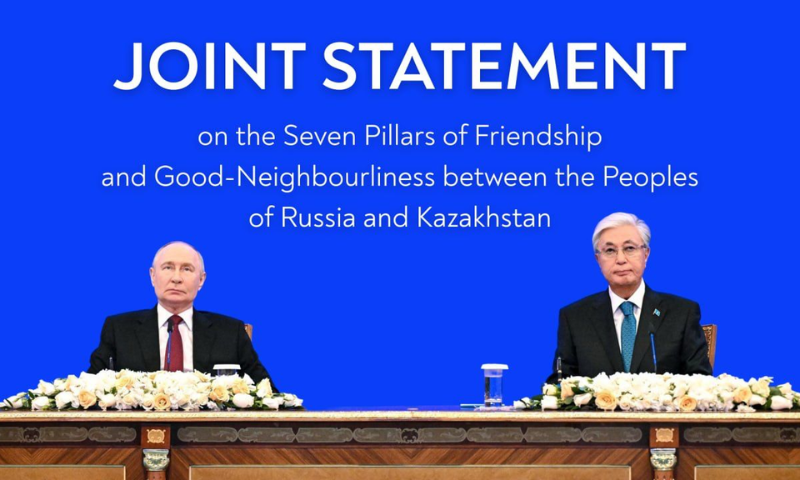
Astana, May 28, 2026: Russian President Vladimir Putin and Kazakh President Kassym-Jomart Tokayev have reaffirmed their commitment to strengthening bilateral ties, regional cooperation, and long-term strategic partnership through a joint statement outlining the “Seven Pillars of Friendship and Good-Neighbourliness” between the peoples of Russia and Kazakhstan.
The joint statement, issued in Astana on Thursday, highlighted the rapidly changing global environment and growing challenges facing the international system.
The two leaders noted that the world is undergoing “profound and rapid change,” with increasing global instability, declining trust, and a reassessment of traditional approaches to security and sustainable development.
Russia and Kazakhstan stressed that there is “no alternative” to building a more just international order capable of ensuring sustainable development and promoting global stability.
The statement emphasized that in times of geopolitical uncertainty, principles such as mutual respect, good-neighbourliness, equal partnership, and consideration of national interests become increasingly important.
According to the statement, the relationship between Russia and Kazakhstan is rooted in shared history, mutual support, and mutually beneficial cooperation.
The two countries agreed to strengthen seven key pillars of bilateral friendship and cooperation.
The first pillar focuses on shared history and a responsible, objective interpretation of historical events in the spirit of friendship and good-neighbourliness.
The second pillar emphasizes joint efforts toward Eurasian integration and the development of a regional space for cooperation, security, and dialogue.
The third pillar highlights the common border between the two countries as a zone of cooperation and neighbourly relations.
Economic partnership was identified as the fourth pillar, reflecting the importance of trade, investment, and economic collaboration between Moscow and Astana.
The fifth pillar underscores linguistic and cultural diversity, traditional values, and civilisational affinity as shared heritage between the two nations.
The sixth pillar focuses on youth cooperation, educational exchanges, and collaboration in sports.
The seventh and final pillar reflects a shared vision for the future, with both countries expressing their desire to continue developing relations as equal partners, strategic allies, and good neighbours.
The statement concluded that strengthening these seven pillars would reinforce trust, stability, and opportunities for future generations in both countries.
Putin and Tokayev also expressed confidence that the longstanding friendship and good-neighbourliness between Russia and Kazakhstan would remain a solid foundation for bilateral relations in the long term.