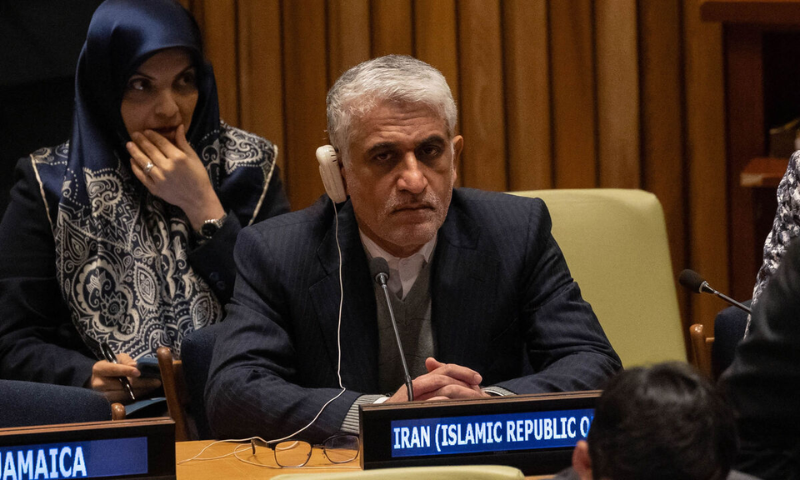
United Nations/Washington, May 29, 2026: Iran’s Ambassador and Permanent Representative to the United Nations, Amir Saeid Iravani, told the UN Security Council on Friday that Tehran’s actions in the Strait of Hormuz were “lawful and consistent with international law,” amid continuing tensions between Iran, the United States and Israel.
Speaking during a high-level open debate of the UN Security Council titled “Upholding the Purposes and Principles of the UN Charter and Strengthening the UN-Centered International System,” Iravani said Iran could not allow “such a critical waterway to be used as a corridor for hostile actions and military aggression against its sovereignty, territory, and vital interests.”
The remarks came as Iranian officials continued to stress the country’s military preparedness following recent confrontations involving US forces in the Gulf region.
Iranian Deputy Foreign Minister for Legal and International Affairs Kazem Gharibabadi said the Islamic Revolutionary Guard Corps’ (IRGC) recent response to what he described as US “actions and mischiefs” demonstrated the full readiness of Iran’s Armed Forces, according to Iran’s state news agency IRNA.
Gharibabadi said Iran would continue strengthening its defense capabilities and warned that any further hostile actions would receive a proportional response. He also emphasized the strategic importance of the Strait of Hormuz and Iran’s sovereignty over the key maritime route.
Meanwhile, Iranian Foreign Ministry spokesperson Esmaeil Baghaei condemned what he described as threats by US officials against Oman after reports emerged regarding possible sanctions linked to discussions over navigation in the Strait of Hormuz.
According to a statement shared by Iran’s Foreign Ministry on X, Baghaei described threats of sanctions as “completely unlawful” and contrary to the principles of the United Nations Charter and international law.
On the other side of the regional dispute, Israeli Prime Minister Benjamin Netanyahu said tensions surrounding the Strait of Hormuz could accelerate the development of alternative global energy routes away from the Gulf region.
Speaking at a seminar in the Jordan Valley, Netanyahu said Israel could potentially become part of a future transport corridor connecting energy routes to the Mediterranean Sea, although he did not provide specific details about the proposed project.
Amid the rising tensions, the US military denied Iranian state media reports claiming that an American aircraft had been shot down near Iran’s Bushehr province.
“No US aircraft were shot down. All US air assets are accounted for,” US Central Command said in a statement posted on X.
Oil markets reacted sharply to reports of a possible diplomatic breakthrough between Washington and Tehran. Brent crude futures fell to $92.69 per barrel, marking their largest weekly decline in nearly two months amid expectations that the Strait of Hormuz could remain open under a potential ceasefire agreement.
According to Reuters, the United States and Iran have reportedly reached a preliminary understanding to extend a ceasefire for another 60 days and ensure unrestricted shipping through the Strait of Hormuz while negotiations continue over Iran’s nuclear program and regional security issues.
However, the proposed agreement has not yet been formally approved by US President Donald Trump, while Iranian state media reported that the deal remains unfinalized.
US Vice President JD Vance said negotiators were “very close” to reaching an agreement but cautioned that discussions were still ongoing.
The proposed deal would reportedly include the easing of some sanctions on Iranian oil exports and the lifting of restrictions on Iranian ports in exchange for guarantees regarding maritime security in the Strait of Hormuz.
The latest developments come amid continued instability across the region, with both Iran and the United States accusing each other of provoking military escalations despite ongoing diplomatic efforts.
Iranian President Masoud Pezeshkian also thanked Pakistan and Malaysia for their diplomatic and humanitarian efforts aimed at reducing tensions and supporting peace initiatives in the region.
In a post on X, Pezeshkian reaffirmed Iran’s commitment to diplomacy and said Tehran seeks to expand cooperation with neighboring and Muslim countries across multiple sectors.