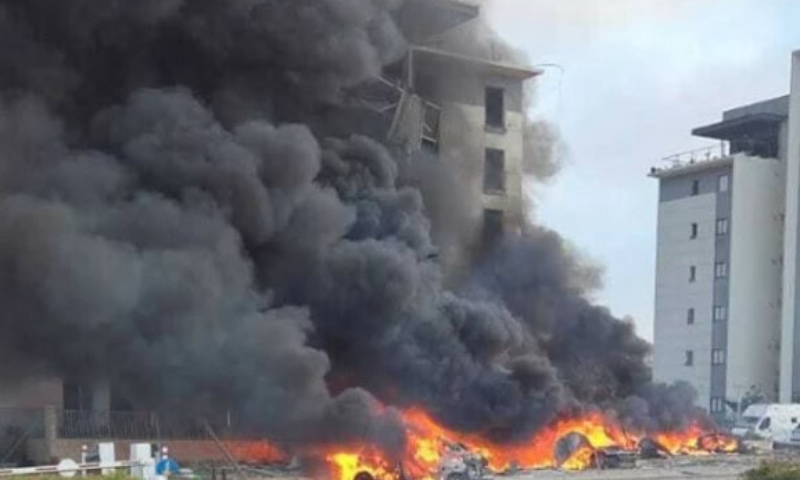
Tel Aviv/Tehran, June 20, 2025: Iran launched its most significant missile strike yet on Israel early Friday, targeting multiple cities and causing widespread destruction, fires, and injuries. The latest escalation in the ongoing conflict saw dozens of ballistic missiles raining down on southern and central Israel, including a direct hit near Microsoft’s office area in Beersheba.
According to Israeli media, a residential neighborhood in Beersheba suffered extensive financial damage after an Iranian missile struck, igniting a massive blaze that engulfed several vehicles and nearby structures. The fire broke out close to a commercial zone housing Microsoft offices. Emergency services, including Magen David Adom and local firefighters, responded swiftly to contain the blaze. No casualties were reported in this strike, though damage assessments continue.
The attack came just a day after another Iranian missile hit Beersheba’s Soroka Medical Center, injuring over 70 people. Israeli authorities have admitted that a technical failure in the missile defense system allowed multiple projectiles to evade interception.
International media reports state that Iran’s latest assault targeted at least four major locations, including the Tel Aviv Stock Exchange and Soroka Hospital. More than 50 people were injured in these coordinated attacks—many critically—marking a dramatic escalation in the regional conflict.
Explosions were heard in Tel Aviv, Holon, and occupied Jerusalem, with Arab media confirming that dozens were wounded in a missile strike in Holon. Iran claimed it had targeted Soroka Hospital based on intelligence alleging the presence of an Israeli military base.
Israel has reportedly responded by targeting Iran’s Arak heavy water reactor. Defense Minister Yoav Gallant issued a blunt warning, stating that the only path to ending the conflict now is through the assassination of Iran’s Supreme Leader Ayatollah Ali Khamenei. “He alone is behind these attacks, and steps will soon be taken to eliminate him,” Gallant declared.
Under what Tehran has dubbed “Operation True Promise III,” Iranian forces used advanced Sejjil missiles for the first time in this conflict. According to Iranian media, these high-altitude, precision-guided missiles were fired at strategic Israeli locations in Tel Aviv and Haifa.
Despite the activation of Israel’s air defense systems, the advanced missiles reportedly evaded interception. Sirens blared across Israeli territory as a combination of missiles, rockets, and drones entered its airspace.
Meanwhile, the White House has said President Donald Trump will decide within the next two weeks whether the U.S. will take direct action in the growing Israel-Iran conflict. White House Press Secretary Karoline Leavitt said Trump remains committed to a diplomatic resolution but is fully prepared to use military force if necessary.
“President Trump wants peace, but he is also a strong leader who won’t hesitate to act if Iran crosses the nuclear threshold,” Leavitt said. She emphasized that the administration’s goal is to prevent Iran from acquiring nuclear weapons, and any potential agreement with Tehran would focus on halting uranium enrichment and dismantling nuclear capabilities.
When asked about the possibility of military intervention without congressional approval, Leavitt responded that the threat from Iran is at its highest in years and that Trump continues to receive intelligence briefings on the evolving situation.
The latest attacks represent the most intense phase of hostilities between Iran and Israel since the conflict reignited. As both sides exchange increasingly sophisticated strikes, regional and global actors are calling for de-escalation to avoid a broader Middle East war.
With tensions at a boiling point, the coming days are expected to test not only military resilience but also diplomatic resolve on both sides—and from global powers watching closely.