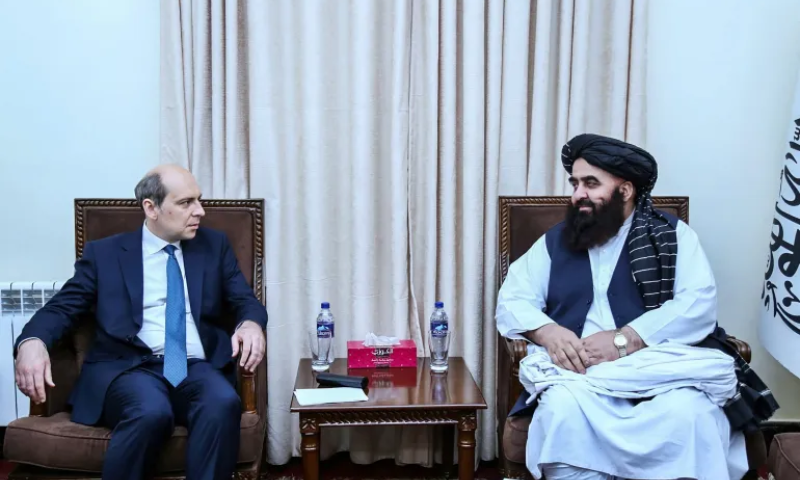
Moscow, July 4, 2025: In a landmark diplomatic move, Russia has officially recognised the Taliban-led government in Afghanistan, becoming the first country to do so since the group returned to power in August 2021.
The Russian Ministry of Foreign Affairs announced on Thursday that it had formally accepted the credentials of the new Afghan ambassador, signalling the beginning of full diplomatic relations with the Islamic Emirate of Afghanistan.
“We believe that the act of official recognition of the government of the Islamic Emirate of Afghanistan will give impetus to the development of productive bilateral cooperation between our countries in various fields,” the ministry said in a statement.
The decision marks a significant shift in international engagement with the Taliban, which has so far remained unrecognised by any country or global body, including the United Nations.
Afghan Foreign Minister Amir Khan Muttaqi welcomed Moscow’s move, describing it as “brave” and “historic.” In a video shared on social media platform X, Muttaqi said, “This brave decision will be an example for others. Now that the process of recognition has started, Russia was ahead of everyone.”
Russia’s recognition of the Taliban government comes amid efforts to build a strategic partnership with Kabul, particularly in the areas of counterterrorism and regional trade. Moscow has previously called the U.S. withdrawal from Afghanistan a “failure” and has steadily moved to normalise ties with the Taliban authorities since 2021.
A Taliban delegation participated in Russia’s St. Petersburg International Economic Forum in 2022 and 2024. In October 2024, the Taliban’s top diplomat met with Russian Foreign Minister Sergey Lavrov in Moscow to deepen diplomatic engagement.
President Vladimir Putin publicly referred to the Taliban in July 2024 as “allies in the fight against terrorism,” particularly in combating the Islamic State Khorasan Province (ISKP), a group responsible for deadly attacks in both Afghanistan and Russia.
In a major legal shift, Russia’s Supreme Court removed the Taliban from its official list of terrorist organisations in April 2025, laying the groundwork for full diplomatic recognition.
Lavrov has since emphasized the importance of a “pragmatic, not ideologised policy” toward the new government in Kabul, acknowledging the Taliban as the de facto rulers of Afghanistan.
Moscow’s recognition of the Taliban marks a dramatic reversal in its decades-long stance. The Taliban—formed in 1994 by ex-Mujahideen fighters who had battled Soviet forces in the 1980s—was designated a terrorist organisation by Russia in 2003 due to its links with North Caucasus separatists.
However, the Taliban’s return to power in 2021 and the rapid collapse of the U.S.-backed Afghan government have forced a strategic recalibration. Russia was one of the first countries to open a business representative office in Kabul post-takeover and is pursuing plans to develop Afghanistan as a transit hub for energy exports to Southeast Asia.
Russia’s decision is expected to be closely scrutinised by Western powers, particularly the United States, which has frozen billions in Afghan central bank assets and maintains sanctions on key Taliban figures. Afghanistan’s banking system remains largely disconnected from international financial channels due to these restrictions.
While no other country or international body has yet recognised the Taliban government, Russia’s move may trigger a ripple effect across the region, especially among neighbouring countries with strategic or economic interests in Afghanistan.
For now, the United Nations continues to refer to the Taliban as the “de facto authorities” and maintains that formal recognition requires measurable progress on human rights, women’s education, and political inclusivity.