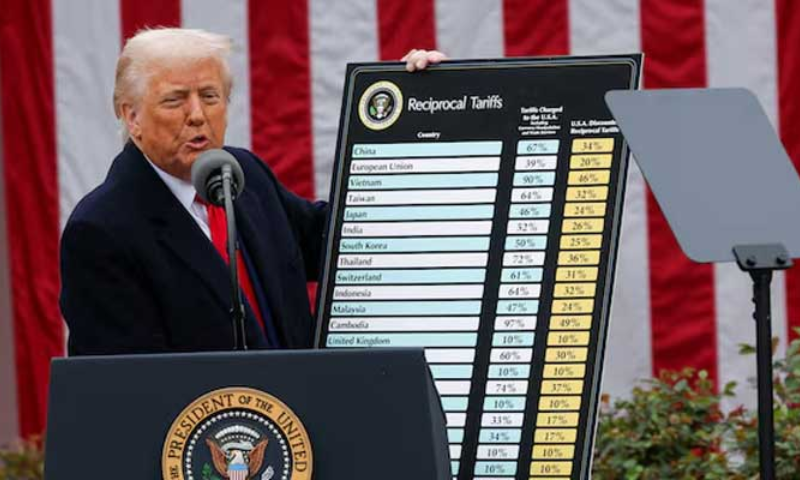
Washington, August 1, 2025: U.S. President Donald Trump has announced a sweeping new round of import tariffs, targeting goods from 69 countries — including a 19% tariff on Pakistani exports — just hours before a key trade deadline.
The tariffs, set to take effect next week, range from 10% to 41% and are part of Trump’s aggressive push to reshape global trade rules and address what he calls “unfair trade imbalances.” Under an executive order issued late Thursday night, countries not specifically listed in an annex will face a uniform 10% tariff rate.
“Some of our trading partners, despite negotiations, have failed to offer terms that sufficiently address the imbalances in our trade or align with U.S. economic and national security interests,” the order stated.
Pakistan is one of the countries now facing a 19% reciprocal tariff, with no indication of having been given the opportunity to negotiate. A senior U.S. official told reporters that more trade deals could still be announced, but declined to name specific countries.
“We have some deals,” the official said. “But I’ll let the President speak on those when ready.”
In a separate executive order, Trump raised the tariff on select Canadian goods from 25% to 35%, citing Canada’s alleged failure to help curb the flow of fentanyl into the U.S. In contrast, Mexico was granted a 90-day reprieve from a planned 30% tariff on most non-automotive and non-metal goods.
Mexican President Claudia Sheinbaum confirmed the delay on social media, calling her Thursday call with Trump “very good.” According to Mexico’s economy ministry, about 85% of U.S. imports from Mexico qualify for exemptions under the U.S.-Mexico-Canada Agreement (USMCA).
However, Trump confirmed that U.S. tariffs of 50% on Mexican steel, aluminium, and copper, and 25% on autos and non-USMCA-compliant goods, would remain in place. He also claimed Mexico had agreed to eliminate numerous non-tariff trade barriers, though details were not provided.
India, meanwhile, is bracing for a 25% tariff on its goods after talks with Washington stalled over agricultural market access and India’s continued oil imports from Russia. Despite ongoing negotiations, Trump has threatened additional penalties. The announcement triggered a drop in the Indian rupee and drew sharp criticism from the opposition at home.
South Korea reached a compromise on Wednesday, agreeing to a 15% tariff — down from a threatened 25% — on exports including automobiles. In exchange, Seoul pledged to invest $350 billion in U.S. projects selected by Trump.
Brazil, Latin America’s largest economy, was hit with a 50% tariff, widely seen as retaliation for the prosecution of Trump ally and former Brazilian president Jair Bolsonaro. However, key Brazilian exports like aircraft, energy, and orange juice were exempted from the higher levies.
At the same time, Trump’s broad use of the 1977 International Emergency Economic Powers Act (IEEPA) is under judicial scrutiny. A federal appeals court is reviewing whether the sweeping tariffs — some reaching 50% — exceed the limits of presidential authority. In May, the U.S. Court of International Trade ruled against the administration, and judges have since raised pointed questions during appellate hearings.
The new tariffs come amid growing evidence that they are driving up consumer prices. Commerce Department data released Thursday showed that prices for home furnishings and durable household equipment rose by 1.3% in June — the largest jump since March 2022. Prices for recreational goods and vehicles climbed 0.9%, while clothing and footwear increased by 0.4%.
Treasury Secretary Scott Bessent said trade negotiations with China were progressing but not finalized. Talks held in Stockholm this week had made headway, but Trump’s final approval was still pending. China faces an August 12 deadline to reach a comprehensive deal, following preliminary agreements reached in May and June aimed at ending tit-for-tat tariffs and securing rare earth mineral supplies.