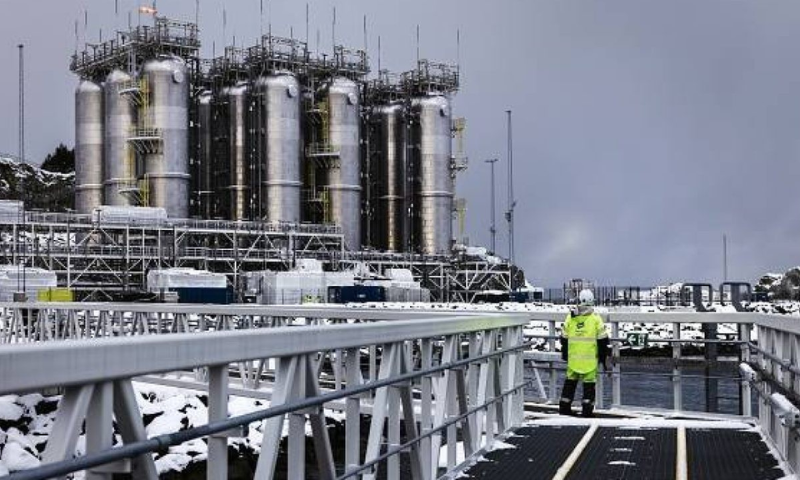
Oslo, August 25, 2025: Norway has launched the world’s first commercial carbon storage service, with the Northern Lights consortium announcing its inaugural injection of CO₂ into the seabed of the North Sea.
The project — a joint venture by Equinor, Shell and TotalEnergies — marks a milestone in efforts to curb climate change by capturing carbon emissions at European smokestacks and storing them permanently underground.
“We have now injected and stored the very first CO₂ safely in the reservoir,” said Tim Heijn, managing director of Northern Lights. “Our ships, facilities and wells are now in full operation.”
Captured CO₂ is liquefied and shipped to the Øygarden terminal near Bergen, before being pumped through a 110-km pipeline into a geological reservoir 2.6 km below the seabed.
The first injection came from Heidelberg Materials’ cement plant in Brevik, southeastern Norway. The UN’s IPCC and the International Energy Agency (IEA) both recognize carbon capture and storage (CCS) as a vital tool to decarbonize hard-to-abate industries such as cement and steel.
However, the technology remains costly and complex. Without subsidies, many companies prefer buying cheaper carbon permits on the European market rather than paying for capture and storage. So far, Northern Lights has signed only three commercial contracts — with Yara’s ammonia plant in the Netherlands, two of Ørsted’s biofuel plants in Denmark, and a Stockholm Exergi power plant in Sweden.
Largely financed by the Norwegian government, the facility has an initial capacity of 1.5 million tonnes of CO₂ annually, with plans to expand to five million tonnes by 2030.