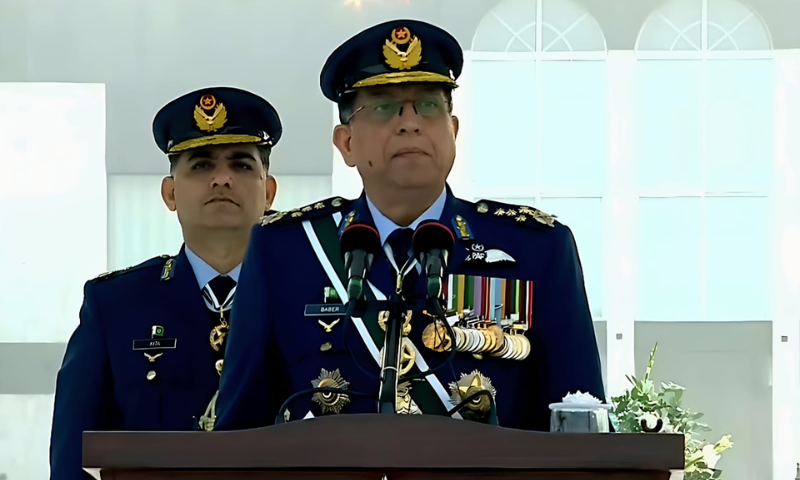
Risalpur, December 2, 2025: Chief of the Air Staff Air Chief Marshal Zaheer Ahmed Baber Sidhu on Tuesday said the world was “stunned” by the Pakistan Air Force’s (PAF) execution of its multi-domain operation against India during the May 2025 military confrontation.
Speaking at a graduation ceremony at PAF Academy Risalpur, the air chief said that, for the first time in Pakistan’s history, the PAF conducted a full-spectrum, integrated operation involving space-based assets, electronic warfare, long-range strike platforms, unmanned aerial systems, killer drones, and loitering munitions.
“The world was stunned to witness the superb execution of Pakistan Air Force’s operation — excellently choreographed and flawlessly executed,” he told the audience.
Air Chief Marshal Sidhu said the region continues to face a “complex global and regional environment,” adding that Pakistan’s adversaries have repeatedly attempted to undermine its sovereignty. He described the May conflict as another manifestation of these threats.
“Alhamdulillah, in a remarkable show of unity, the people of Pakistan and its forces defeated the enemy with far greater numerical might,” he said.
He credited the success of Marka-e-Haq and Bunyan-um-Marsoos operations to a unified national approach and “Allah’s special blessings.”
Recalling the night of May 6 and 7, the air chief said Pakistan’s sovereignty was challenged, prompting the PAF to “uphold its legacy of fighting outnumbered.”
He claimed the PAF shot down multiple advanced Indian aircraft — including Rafale, Su-30MKI, Mirage 2000, MiG-29 jets, and unmanned systems — adding that the force possessed “solid evidence and electronic signatures” of the engagements.
“This fierce aerial engagement is being regarded as one of the most intense and longest battles in modern aerial history, leaving the enemy’s skies silent for the remainder of the conflict,” he said.
Commenting on the broader operation, Air Chief Sidhu said that on May 10, the PAF and Pakistan Army launched a coordinated response targeting Indian military infrastructure.
“We struck their bases and ground assets deep inside enemy territory from north to south, besides neutralising the state-of-the-art S-400 air defence system and command-and-control centres,” he said.
He added that while the PAF possessed the capability to push further, Pakistan’s “mature strategic culture” guided decisions to ensure actions remained “effective yet calibrated,” with peace and national honour as the ultimate objectives.
The confrontation between Pakistan and India earlier this year was the most serious military escalation between the two nuclear-armed rivals in decades. The standoff began after a terrorist attack on tourists in Pahalgam, Indian Illegally Occupied Jammu and Kashmir (IIOJK), which New Delhi accused Pakistan of supporting.
Islamabad strongly rejected the allegation and offered to participate in a neutral international investigation into the attack, which killed 26 people.
During the clashes, Pakistan claimed to have downed seven Indian fighter jets — including three Rafale aircraft — as well as dozens of drones. The conflict lasted at least 87 hours and ended on May 10 following a US-brokered ceasefire agreement.