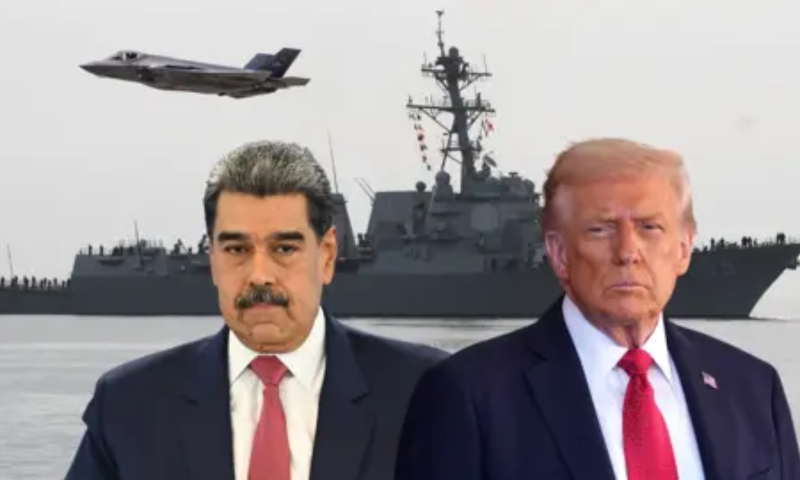
Washington/Caracas, January 3, 2026: US President Donald Trump announced on Saturday that American forces had captured Venezuelan President Nicolas Maduro in a large-scale military operation early Saturday morning, and that Washington would govern Venezuela temporarily until a safe and proper transition could take place.
Addressing a press conference at his Mar-a-Lago resort in Florida, Trump said, “No nation in the world could achieve what America achieved yesterday. All Venezuelan military capacities were rendered powerless as the men and women of the US military, working with law enforcement, successfully captured Maduro in the dead of night.”
According to Trump, Maduro and his wife, Cilia Flores, were transported aboard the USS Iwo Jima to New York, where they face charges including narco-terrorism conspiracy, cocaine importation conspiracy, and possession of machine guns and destructive devices in the Southern District of New York. US Attorney General Pam Bondi praised the military operation, calling it “incredible and highly successful.”
Trump described the operation as “extremely complex” and praised the professionalism and planning of the US forces. He noted that there were “a few injuries on our side” but no American personnel were killed. The operation had been delayed by bad weather, and Maduro was reportedly captured in a heavily fortified location. Trump also rejected Maduro’s attempts to negotiate during the operation.
Trump confirmed that the US would remain involved in Venezuela, including oversight of its oil industry, and warned that Maduro loyalists remaining in the country “are going to have a bad future.” He also claimed the operation was unrelated to Mexico, despite linking it to broader anti-drug objectives along the US southern border.
International reaction
Venezuelan officials have strongly condemned the US operation. Vice President Delcy Rodriguez demanded immediate proof of life for Maduro and Flores. Defence Minister Vladimir Padrino López accused US forces of striking residential areas and vowed a “massive deployment” of Venezuelan military capabilities in response. Interior Minister Diosdado Cabello affirmed that Venezuela “will overcome” the attacks.
Colombian President Gustavo Petro criticized the US action as “an assault on the sovereignty of Latin America” and warned it could trigger a humanitarian crisis. The UN Security Council is set to discuss the situation following Venezuela’s emergency request.
Domestic US response
Trump’s announcement has raised questions in the US over the legality of the strikes, as Congress holds the constitutional authority to declare war. Analysts have predicted potential short-term spikes in oil prices due to the operation, though longer-term effects could be mitigated if sanctions are lifted and foreign investment returns under a new Venezuelan government.
Background
The operation follows months of mounting US military and economic pressure on Maduro, whom Washington has accused of running a “narco-state” and rigging the 2024 election. Maduro, who has ruled Venezuela since succeeding Hugo Chavez in 2013, has long claimed that the US aims to control Venezuela’s oil reserves—the second-largest in the world.
Explosions were reported in Caracas and other locations early Saturday, including Fort Tiuna and Carlota Airbase, while blasts were heard in La Guaira near the capital’s airport and port. Residents reported smoke, explosions, and aircraft activity across the city.
The operation recalls past US interventions in Latin America, including the 1989 invasion of Panama, and evokes historical doctrines such as the Monroe Doctrine and Roosevelt-era “gunboat diplomacy.”