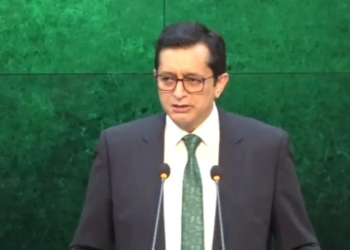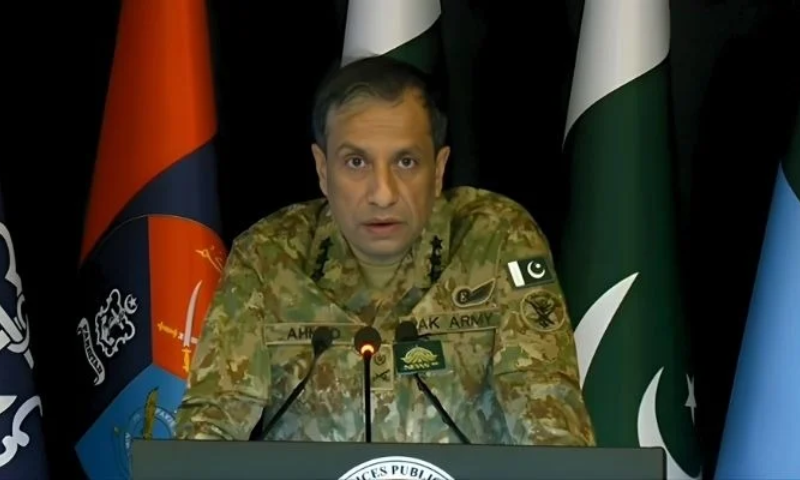
Rawalpindi, January 6, 2026: Director General Inter-Services Public Relations (ISPR) Lieutenant General Ahmed Sharif Chaudhry on Tuesday strongly criticised the Pakistan Tehreek-e-Insaf (PTI) leadership in Khyber Pakhtunkhwa (KP), holding it responsible for the sharp rise in terrorism in the province and accusing it of resisting counterterrorism efforts.
Addressing a press briefing in Rawalpindi, Lt Gen Chaudhry said that nearly 71 per cent of terrorist incidents reported in 2025 occurred in KP, attributing the trend to what he described as a “politically conducive environment” and the flourishing of a “political-criminal-terror nexus” in the province. He said the KP government was seeking help from Afghanistan while simultaneously opposing counterterrorism operations at various forums.
Citing an annual report by the Centre for Research and Security Studies (CRSS), the ISPR chief noted that fatalities in KP rose from 1,620 in 2024 to 2,331 in 2025—an increase of more than 40 per cent year-on-year.
He dismissed KP Chief Minister Sohail Afridi’s stance on negotiations and calls for Afghan security guarantees, questioning opposition to military operations. “If you do not want a military operation, then what should be done—sit at the feet of khawarij?” he asked, calling the chief minister’s remarks against operations “ridiculous.”
Lt Gen Chaudhry said seeking assurances from groups accused of harbouring terrorists was illogical, stressing that effective counterterrorism required firm state action rather than political ambiguity. He also linked illegal mining and the proliferation of illegal weapons in KP directly to terrorism.
India–Afghanistan nexus
Addressing regional security, the ISPR chief said Afghanistan had become a centre of terrorist activity in the region and accused the Afghan Taliban regime of failing to uphold commitments made under the 2020 Doha Agreement to prevent the use of Afghan soil for terrorism. He claimed that all major terrorist organisations targeting Pakistan were based in Afghanistan and were being nurtured there.
He further alleged that the nexus between Fitna al-Khawarij (TTP) and India became fully exposed in 2025, posing a serious threat to regional peace. He said Pakistan had responded forcefully to attacks on its border posts and targeted terrorists along the Afghan border in October 2025, eliminating dozens of hostile posts within hours.
Rejecting allegations that the Pakistan Army uses drones to target civilians, Lt Gen Chaudhry clarified that drones are primarily used for surveillance. He alleged that TTP militants were using armed quadcopters, with support from India, and accused terrorists of using mosques, residential areas, and civilians—including women and children—as human shields.
Counterterrorism operations
Providing details of counterterrorism efforts in 2025, the ISPR DG said law enforcement agencies conducted 75,175 intelligence-based operations nationwide. Of these, 14,658 were carried out in KP, 58,778 in Balochistan, and 1,739 in other parts of the country.
He said 5,397 terrorism incidents were reported nationwide last year, including 3,811 in KP and 1,557 in Balochistan. During these operations, 2,597 terrorists were killed. He added that Afghan militants were involved in all 10 major terror attacks reported in 2025, with civilians and soft targets deliberately targeted.
Referring to major incidents, he said 21 civilians were martyred in the Jaffar Express attack, eight civilians were killed in an attack on the Frontier Corps headquarters in Quetta, and a civilian bus was targeted in Noshki. He also said Afghan terrorists attempted an attack on Cadet College Wana in November, attempting to replicate the 2014 APS Peshawar tragedy.
‘National war against terrorism’
Lt Gen Chaudhry stressed that Pakistan’s fight against terrorism was a collective national war, not solely the responsibility of the armed forces. “This is a war of the nation, of every single child,” he said, reiterating that Pakistan makes no distinction among terrorists.
He said refugee camps in Punjab and Balochistan had been cleared, while most camps in KP were still present. He also warned that social media was increasingly being misused for terrorism, crime, and propaganda, calling for strict enforcement of laws to protect citizens.
Concluding his briefing, the ISPR chief said no political party or individual was above Pakistan and that the armed forces stood firmly within the constitutional framework. “We are on the side of truth,” he said, adding that Pakistan’s counterterrorism campaign was unparalleled and would continue until terrorism is eliminated.