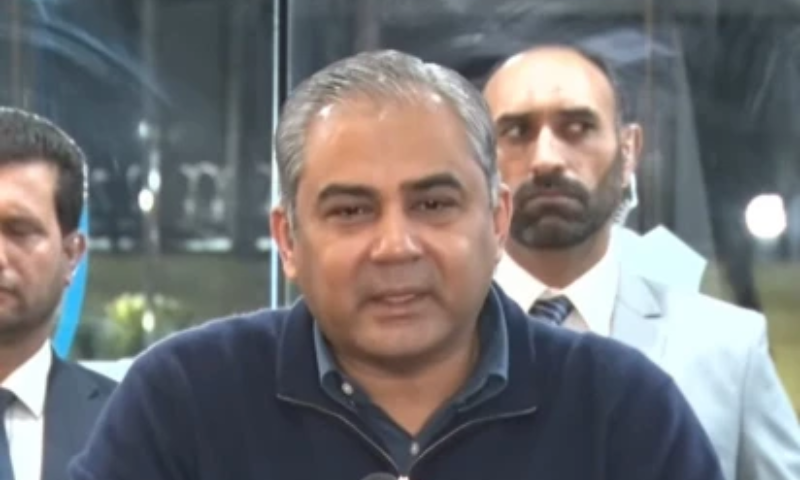
Islamabad, February 7, 2026: Interior Minister Mohsin Naqvi announced on Saturday that four facilitators of the suicide attack at an Imambargah in Islamabad, including the “main mastermind,” have been arrested following coordinated raids in Khyber Pakhtunkhwa. The arrests mark a significant breakthrough in the investigation into the deadliest terrorist attack in the capital in nearly two decades.
Speaking to the media, Minister Naqvi said the operations were conducted throughout the night, culminating in the apprehension of all suspects by around 3:00 am. “All those people linked to this, and the mastermind, at around 3 am, all of them were apprehended,” he said, praising the Counter-Terrorism Department (CTD) and KP police for their joint efforts. He described the case as a “test case” for Pakistan’s law enforcement agencies.
The Interior Minister revealed that the main mastermind is an Afghan national affiliated with the banned Islamic State (Daesh), and that planning and training for the attack were carried out in Afghanistan. “We have people who are telling us details about how he (the attacker) went there and how he was trained,” Naqvi said. He confirmed that one assistant sub-inspector of KP police was martyred during the raids, while several others were injured.
Naqvi stressed that the attack was part of a broader nexus of terrorist organizations operating under Afghan Taliban patronage. “Whether it be Tehreek-i-Taliban Pakistan (TTP), Afghan Taliban, Daesh or other kharji terrorist organizations — they are all working together. At this time, 21 terrorist bodies’ setups … name any terrorist body, it is operating from Afghanistan,” he said.
The Interior Minister further highlighted that terrorist groups are increasingly being funded from external sources. “They would get $500 but now they’re getting $1,500. Someone’s increasing their budget,” he said, pointing fingers at India, claiming that New Delhi is allegedly providing funding, operational targets, and strategic direction for attacks inside Pakistan. “All of their funding comes from India. India is giving them all the targets; they are planning each and every thing behind the scenes. These organizations are at the front, while India is at the back,” he added.
Naqvi said Pakistan would present evidence of such external involvement at international forums. “We know about this and it is our duty to take this case to all international platforms,” he stated. He noted that the attacks, including the recent blast, are part of a growing regional threat and that Pakistan’s law enforcement agencies are fully committed to neutralizing it.
The Interior Minister appealed to the public for assistance in counter-terrorism efforts. “We are in a state of war; be it in Balochistan, KP or elsewhere. The intelligence from the community matters the most. When people get to know about an unknown person living in their community, report it to the police — when this system is activated, incidents will decrease,” he said.
Naqvi also sought to reassure the public about ongoing security measures. “If one blast happens, 99 others are being foiled. We should share this with the media, even if it spreads panic, so that people understand the scale of what has been prevented,” he said.
He also highlighted concerns regarding the use of social media by terrorists, noting that multiple accounts remain active on platforms like X (formerly Twitter). “The government has written to them, but they are not blocked here, so we have taken this up very seriously. If they do not do it, we may have to adopt another strategy,” he said.
On security arrangements in Islamabad, Naqvi confirmed that a detailed review of 93 entry points and red-zone protocols had been conducted. “The chief commissioner or Islamabad inspector general will brief you within the coming days,” he added.
According to the Ministry of Interior, coordinated raids based on technical and human intelligence were conducted in Peshawar and Nowshera districts of Khyber Pakhtunkhwa. These operations led to the arrest of four facilitators, including the Afghan ISIS mastermind. Evidence confirmed that planning, training, and indoctrination for the attack were carried out in Afghanistan.
During the late-night raid in Nowshera’s Hakeemabad area, an exchange of fire occurred between law enforcement and militants. An assistant sub-inspector of the KP police was martyred, and a constable sustained injuries. Police officials confirmed that the raid was conducted as part of the ongoing investigation into the Islamabad Imambargah bombing, with participation from multiple agencies.
Friday’s suicide attack in Islamabad killed dozens and injured over a hundred, marking it as the deadliest in the capital since the September 2008 Marriott Hotel bombing that claimed 60 lives. The blast also follows a November 11, 2025 suicide attack near the G-11 district and sessions court, which killed 12 people and injured more than 30.
Minister Naqvi warned that terrorist organizations are collaborating across borders and targeting Pakistan strategically. He cited the Baloch Liberation Army (BLA) as another example of Indian-backed destabilization efforts in the region, claiming that Indian media promotes BLA propaganda despite the group being designated a terrorist organization internationally.
On the investigation, Naqvi confirmed that the operation against the main Daesh operative had been ongoing since his arrival in Pakistan. He also noted that further details, including the rank of the ISIS mastermind, would be disclosed in due course.
The Interior Ministry concluded that while Pakistan’s security forces are making significant progress, the threat remains regional. “Our forces remain resolute; further intelligence-based operations are underway,” the Ministry said in an official statement on social media.
Minister Naqvi stressed Pakistan’s ongoing commitment to combating terrorism at all levels and stated that the country would continue to neutralize threats regardless of external support to terrorist groups. He emphasized that international attention and cooperation are essential to prevent the spillover of violence into other regions, warning that failure to address these networks would have global implications.