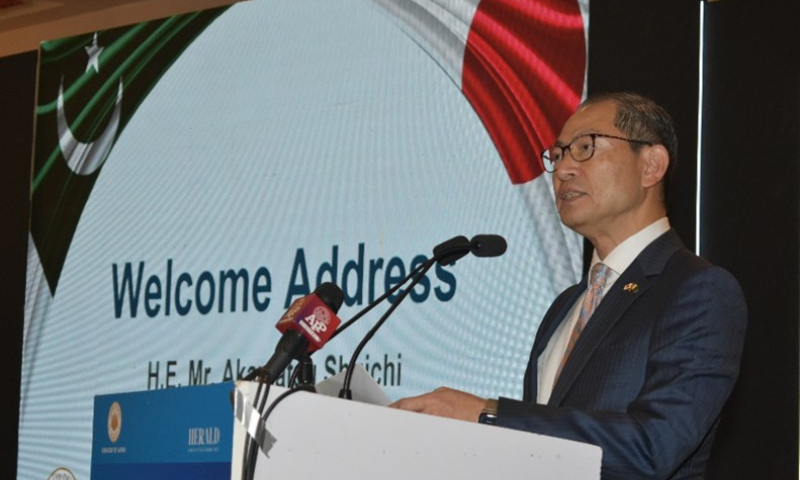
Islamabad, February 10, 2026: Japanese Ambassador to Pakistan, Mr. Akamatsu Shuichi, hosted the “Japan-Pakistan Business Seminar 2026” at a hotel in Islamabad, bringing together around 100 participants from government, business, academia, and leading Japanese organizations to explore opportunities for enhanced bilateral trade and investment.
The event was attended by Special Assistant to the Prime Minister for Industries and Production Haroon Akhtar Khan as chief guest, along with officials, representatives of the Japan Chamber of Commerce and Industry in Pakistan, the Japan International Cooperation Agency (JICA), the Japan External Trade Organization (JETRO), and executives from Japanese companies.
In his remarks, Ambassador Akamatsu highlighted the significant contribution of Japanese automotive firms, noting that they have created over 100,000 jobs in Pakistan and localized more than 60% of automotive components through domestic supply chains. He added that continued investment in new technologies is helping advance industrial upgrading while reducing environmental impacts. “Countries capable of manufacturing automobiles are limited, and Japan’s contribution to Pakistan’s economy is substantial and will remain so,” he said.
Haroon Akhtar Khan expressed gratitude for Japan’s longstanding economic support and voiced optimism about further strengthening bilateral relations.
The seminar featured two panel discussions. The first examined Japan’s economic growth and the history of business ties with Pakistan, emphasizing a culture that prioritizes education and long-term investment over immediate profits. Panelists discussed how Pakistan could draw lessons from Japan’s development model.
The second session brought together Japanese automakers and Pakistani auto parts suppliers, who highlighted the importance of Kaizen, 5S practices, and workforce training in achieving stable, high-quality production. Discussions also focused on the sector’s future, including the promotion of hybrid vehicles, investment in biogas fuel to reduce petrol consumption, enhanced safety standards, and continued development of local suppliers.