Tehran, March 13,2026: Deadly explosions struck areas near a pro-government rally in Tehran on Friday as the war between Israel and Iran escalated, raising fears of a wider regional conflict and severe disruption to the global economy.
The conflict, which erupted on February 28 following joint attacks by Israel and the United States on Iranian targets, has since spread across the region, drawing in international actors and triggering a major oil market shock.
Journalists from Agence France-Presse (AFP) in Tehran reported loud explosions across the capital’s skyline as the Israeli military said it had struck more than 200 targets in western and central Iran within the past 24 hours.
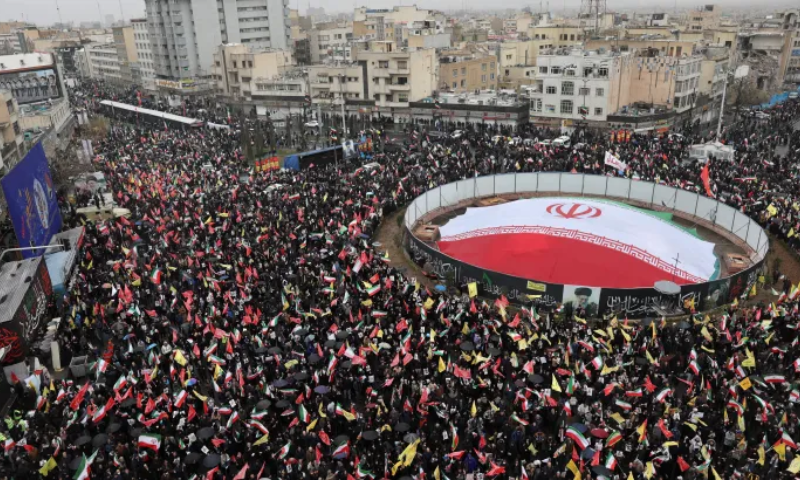
Iranian state media reported that at least one person was killed after blasts hit an area near a pro-government demonstration marking Quds Day, the last Friday of Ramadan. Large crowds had gathered waving Iranian flags and chanting slogans against Israel and the United States.
Senior Iranian leaders, including President Masoud Pezeshkian and Foreign Minister Abbas Araghchi, attended the rally. Ali Larijani, secretary of Iran’s Supreme National Security Council, condemned the strikes, saying they reflected “fear and desperation” by Israel.
Iran’s powerful Islamic Revolutionary Guard Corps (IRGC) warned that any renewed anti-government protests would face a tougher crackdown than the one earlier this year.
War spreads across the region
The conflict has increasingly spilled beyond Iran and Israel, with drone and missile attacks reported across several countries hosting US or allied forces.
Saudi Arabia said its air defences intercepted dozens of drones, including one targeting Riyadh’s Diplomatic Quarter. In the United Arab Emirates, smoke was seen rising over Dubai after a drone strike.
Authorities in Oman reported two deaths caused by drone debris, while alarms sounded at Incirlik Air Base in Turkey, a key NATO facility hosting US troops. Turkish officials later said air defence systems intercepted a ballistic missile from Iran inside Turkish airspace.
Meanwhile, Emmanuel Macron announced that a French soldier had been killed in an attack in the Erbil region of Iraq during a mission involving counter-terrorism training with Iraqi forces.
In Israel, a strike on the town of Zarzir injured about 60 people, according to police.
Humanitarian and economic fallout
The war has also devastated neighbouring Lebanon, where authorities say 687 people have been killed in Israeli strikes. One attack on Beirut’s seafront on Thursday alone killed at least 12 people.
According to the United Nations High Commissioner for Refugees, up to 3.2 million people have been displaced inside Iran since the conflict began. Iran’s health ministry earlier said more than 1,200 people had been killed as of March 8, though the figures have not been independently verified.
Oil shock and Strait of Hormuz threat
Global energy markets have also been shaken by the conflict. Crude oil prices have surged above $100 per barrel after Iranian leaders threatened to block the strategically vital Strait of Hormuz, through which a significant portion of the world’s oil supply passes.
A message attributed to Mojtaba Khamenei, who reportedly assumed leadership after his father’s death in earlier strikes, called for using the strait as leverage against adversaries.
The International Energy Agency warned that the conflict has created “the largest supply disruption in the history of the global oil market.”
Amid rising energy prices worldwide, US President Donald Trump has eased some oil sanctions on Russia to stabilise supply, a move criticised by Germany, which warned it could bolster Russian President Vladimir Putin amid the ongoing war in Ukraine.