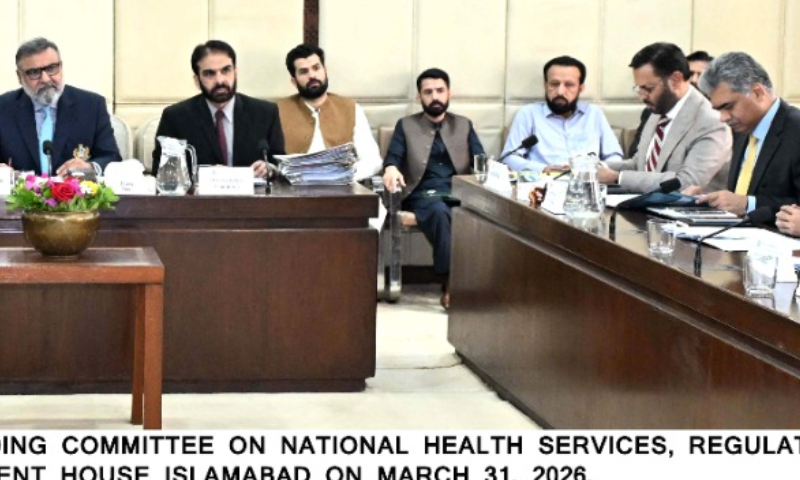
Islamabad, March 31, 2026: The Senate Standing Committee on National Health Services, Regulations and Coordination on Tuesday called for stricter regulation of the private medical sector and reforms in admission criteria, amid growing concerns over rising costs and declining standards.
The meeting, held in Islamabad, was chaired by Senator Amir Waliuddin Chishti and attended by several lawmakers, including Rubina Khalid and others.
During the session, Senator Rubina Khalid raised concerns about the escalating prices of pharmaceutical products in the market. Officials from the Drug Regulatory Authority of Pakistan briefed the committee on the pricing mechanism and assured that a detailed report would be submitted within 14 days.
The authority also informed the panel that a survey covering 50 percent of pharmaceutical products would be conducted to assess pricing trends. The committee chairman directed that a comprehensive report be presented in the next meeting.
The committee was also briefed on entry test criteria for medical and dental colleges across various Asian countries. Emphasizing the need for standardization, the chairman directed authorities to align Pakistan’s admission criteria with international standards.
The Federal Minister for National Health Services highlighted concerns over foreign medical education, noting that in some countries even academically underqualified students are able to secure admission. He revealed that less than one percent of foreign-qualified graduates manage to pass the National Registration Examination (NRE), raising questions about quality.
The committee recommended that vacant MBBS and BDS seats be filled using the same formula adopted last year, after it was revealed that some seats remained unfilled.
Concerns were also raised over the increase in seats in certain institutions. The minister clarified that while some expansion is being considered to reduce the number of students going abroad, a three-year cap has been imposed on seat increases, restricting colleges from expanding intake during this period.
Officials from the Pakistan Medical and Dental Council informed the committee about recent developments, including the implementation of the Nursing Council Act and the successful conduct of elections for its leadership.
The committee emphasized the need to strengthen both public and private medical institutions to provide quality education within Pakistan. Lawmakers stressed that improving domestic capacity would help reduce the outflow of students seeking education abroad.
The minister revealed that the trend of students pursuing medical education overseas results in an estimated annual foreign exchange outflow of around $800 million.
The committee urged the government to enhance facilities in local institutions and align MDCAT admission criteria with global standards, enabling more students to study within Pakistan while preserving valuable foreign exchange reserves.