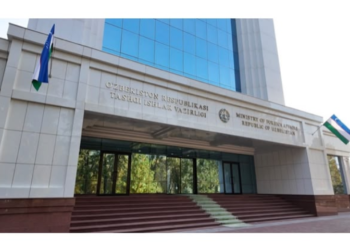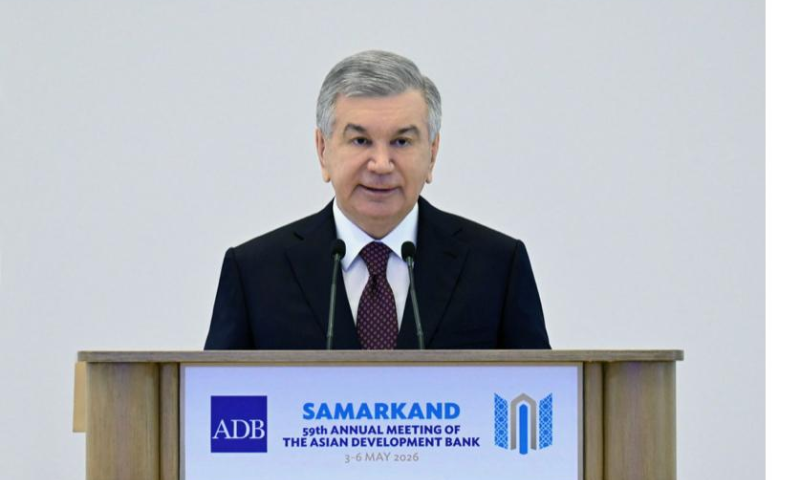
Tashkent, May 4, 2026: President Shavkat Mirziyoyev on Monday called for stronger regional cooperation, accelerated digital transformation, and expanded investment in green energy and infrastructure while addressing the 59th Annual Meeting of the Board of Governors of the Asian Development Bank (ADB) in Tashkent.
Welcoming delegates from more than 100 countries, Mirziyoyev described Uzbekistan as a historic crossroads of civilization and trade along the ancient Silk Road, adding that “New Uzbekistan” was emerging as a major platform for dialogue on global economic and development challenges.
The Uzbek president highlighted sweeping economic reforms introduced since 2016, stating that the country had attracted $150 billion in foreign investment in recent years while expanding electricity production, tripling exports, and increasing the size of the economy from $50 billion to $147 billion.
He said Uzbekistan achieved 8.7 percent economic growth during the first quarter of 2026 despite global instability and noted that poverty had declined from nearly 35 percent to 5.8 percent due to reforms focused on improving living standards.
Mirziyoyev said the government aims to expand the economy to more than $240 billion by 2030 and transform Uzbekistan into an upper-middle-income country through innovation-driven growth and technological modernization.
The president praised the Asian Development Bank as a “trusted strategic partner,” noting that Uzbekistan and the ADB are implementing projects worth nearly $16 billion. He also announced the signing of a new $12 billion cooperation programme with the bank focused on poverty reduction, human capital development, and infrastructure.
Addressing emerging global challenges, Mirziyoyev emphasized the growing importance of digital technologies and artificial intelligence, revealing that Uzbekistan is developing more than 200 AI-related projects and establishing an Artificial Intelligence Hub.
He proposed launching a special ADB-backed programme to scale up artificial intelligence in developing countries and announced Uzbekistan’s participation in the “Digital Highway for Asia” initiative, suggesting that its regional coordination center be established in Tashkent.
The Uzbek leader also stressed the importance of renewable energy development, saying Uzbekistan had launched major wind and solar projects with a combined capacity of 5,600 megawatts, raising the share of green energy generation to 30 percent. He said the country aims to increase this figure to 54 percent by 2030.
Mirziyoyev further called for enhanced regional transport and logistics integration, highlighting the strategic significance of the China–Kyrgyzstan–Uzbekistan railway project, which he said would significantly reduce cargo delivery times and increase transit capacity across Central Asia.
He proposed establishing a “Digital Customs and Logistics Alliance” under the ADB-backed CAREC programme to simplify customs procedures and improve regional connectivity.
On climate change, the Uzbek president outlined national environmental initiatives, including the planting of 200 million trees annually and the creation of green forests on the dried bed of the Aral Sea. He also proposed launching a regional “Central Asia Green Belt” project.
Mirziyoyev additionally called for deeper cooperation in tourism, critical minerals, and private-sector investment, while proposing the establishment of an innovative financing platform for regional development projects.
The forum brought together more than 4,000 delegates, including representatives of international financial institutions, major banks, and global companies.