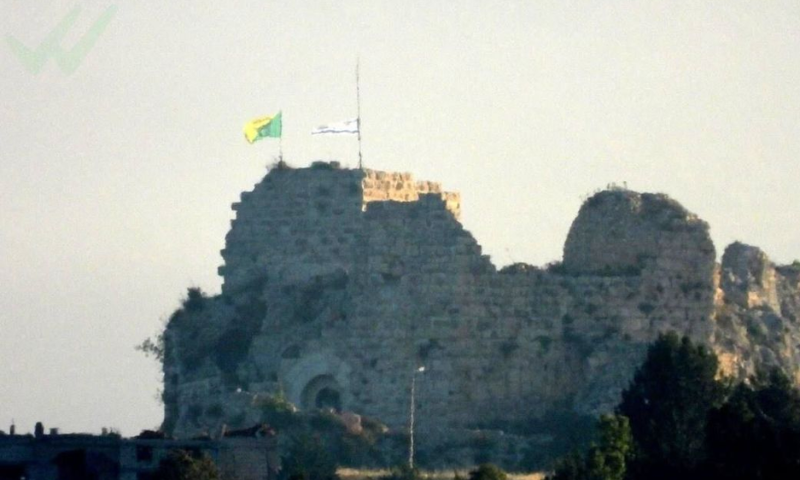
Beirut/Tel Aviv, May 31,2026: Israel said its forces have seized the medieval Beaufort Castle in southern Lebanon, marking what reports describe as the deepest Israeli ground incursion into Lebanese territory in 26 years, amid a major escalation in cross-border hostilities with Hezbollah.
The capture of the 900-year-old fortress and its surrounding ridge was confirmed by Israeli Defence Minister Israel Katz, who said troops had expanded ground operations under orders from the government and military leadership.
“Forty-four years after the heroic Battle of Beaufort… our troops have returned to the summit of Beaufort and once again raised the Israeli flag there,” Katz said in a post on social media, adding that Israeli forces had crossed the Litani River and secured the strategic position overlooking southern Lebanon.
The advance was accompanied by heavy shelling, with smoke reported in the surrounding areas as Israeli troops pushed deeper into Lebanese territory. The Associated Press reported that the operation represents Israel’s most significant incursion into Lebanon since its withdrawal in 2000, following an 18-year occupation that began in 1982.
Ahead of the offensive, the Israeli military issued broad evacuation warnings to civilians in large parts of southern Lebanon, including areas south of the Zahrani River and north of the Litani River.
Military spokesperson Avichay Adraee warned residents to avoid areas allegedly linked to Hezbollah activity, saying any buildings used for military purposes could be targeted.
The Israeli army described the ground operation as an expansion of its “forward defence line,” stating that additional areas were now under active military operations.
Lebanon’s government strongly condemned the Israeli advance, with Prime Minister Nawaf Salam accusing Israel of pursuing a “scorched-earth policy and collective punishment” in the south.
He warned that ongoing strikes were destroying towns and villages and forcing mass displacement of civilians.
Despite diplomatic engagement efforts, Salam said negotiations mediated by the United States remained uncertain but could still represent “the least costly path” to de-escalation.
Hezbollah forces have continued to engage Israeli troops in multiple southern Lebanese locations, including around Zawtar al-Sharqiyah, Yohmor al-Shaqif, and Dibbine, according to statements from the group.
The armed group claimed Israeli forces had not fully secured several targeted towns, while also launching attacks into northern Israel.
Israeli authorities reported more than 25 projectiles fired from Lebanon on Saturday, triggering air raid sirens in northern cities including Karmiel and Safed for the first time since a previously declared ceasefire.
The Israeli military confirmed that one soldier was killed by an explosive drone attack attributed to Hezbollah, bringing the number of Israeli military fatalities in Lebanon since early March to 25.
Meanwhile, Lebanon’s health ministry said Israeli strikes have killed more than 3,371 people since early March, underscoring the heavy human toll of the ongoing conflict.
A ceasefire formally announced in April has effectively collapsed, with both Israel and Hezbollah accusing each other of repeated violations. Cross-border attacks and military operations have continued despite diplomatic efforts.
US-brokered military-to-military talks were held in Washington on Friday, with further political-level discussions expected next week. However, officials have acknowledged that the outcome of negotiations remains uncertain.
Hezbollah has rejected direct talks with Israel, complicating efforts to restore stability along the border as fighting continues to intensify.