Islamabad, June 1, 2026: Pakistan and the European Union (EU) on Monday reaffirmed their commitment to deepening strategic engagement across a wide range of areas, including trade, investment, security, climate action, migration, human rights, and regional peace, during the 8th Round of the Pakistan-EU Strategic Dialogue held in Islamabad.
PM Shehbaz meets Kaja Kallas
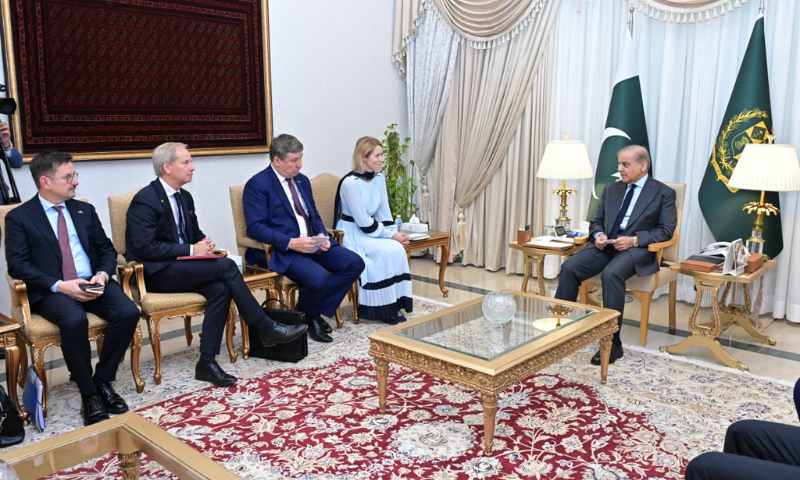
Later in the day, Prime Minister Shehbaz Sharif held a separate meeting with Kaja Kallas at the Prime Minister House.
The meeting was attended by Deputy Prime Minister Ishaq Dar, Law Minister Azam Nazeer Tarar, Attorney General Mansoor Usman Awan, Special Assistant to the Prime Minister Tariq Fatemi and senior government officials.
Prime Minister Shehbaz Sharif welcomed the EU High Representative and reaffirmed Pakistan’s desire to further strengthen its multifaceted partnership with the European Union.
Expressing satisfaction over the successful Strategic Dialogue, the prime minister highlighted opportunities for enhanced cooperation in trade and investment, climate change, security, migration, sustainable development and regional connectivity. He also emphasized the vital role of GSP+ in strengthening Pakistan-EU trade relations.
The prime minister thanked the EU leadership for supporting Pakistan’s peace efforts in the Gulf region and noted that Deputy Prime Minister Ishaq Dar and Syed Asim Munir had been playing an important role in advancing diplomatic initiatives aimed at regional stability.
He further shared Pakistan’s perspective on South Asian developments and Afghanistan and conveyed his best wishes to Antonio Costa and Ursula von der Leyen, while reiterating invitations for both leaders to visit Pakistan.
Kaja Kallas appreciated Pakistan’s role in promoting regional peace and conveyed the European Union’s strong interest in expanding and deepening its strategic partnership with Pakistan.
The two sides agreed to hold the 9th Round of the Pakistan-EU Strategic Dialogue in Brussels, reaffirming their commitment to sustained engagement and closer cooperation on bilateral, regional and global issues.
8th Strategic Dialogue
The dialogue was co-chaired by Deputy Prime Minister and Foreign Minister Mohammad Ishaq Dar and EU High Representative for Foreign Affairs and Security Policy and Vice-President of the European Commission Kaja Kallas.
According to a joint press communiqué issued after the meeting, both sides reviewed the broad spectrum of bilateral relations under the Pakistan-EU Strategic Engagement Plan 2019 and agreed to continue exploring new opportunities to strengthen cooperation in areas of mutual interest.
The two sides exchanged views on the evolving global landscape and underscored their shared commitment to multilateralism, the principles of the UN Charter, international law, peace, prosperity, and respect for human rights. They emphasized the importance of strengthening a rules-based international order with the United Nations at its core.
Trade, investment and GSP+ remain central
Pakistan and the EU welcomed the growing momentum in bilateral relations, highlighted by increasing high-level exchanges and the successful convening of the first Pakistan-EU Business Forum in Islamabad on April 28-29, 2026.
The forum attracted significant interest from businesses on both sides and resulted in the launch of the EU-Pakistan Business Network, aimed at promoting stronger economic cooperation and investment opportunities. Both sides agreed to consider holding the business forum on a regular basis.
Economic cooperation remained a key focus of the dialogue, with both parties reiterating the importance of continued collaboration under the EU’s Generalised Scheme of Preferences Plus (GSP+). The EU briefed Pakistan on its upcoming GSP+ regulation framework, while Pakistan expressed strong interest in joining the new scheme. Both sides agreed to work closely to meet the relevant requirements.
The dialogue also reaffirmed the importance of promoting and protecting human rights and fundamental freedoms in line with international obligations.
Security, counterterrorism and migration cooperation
Pakistan and the EU discussed cooperation on counterterrorism within the framework of their strategic engagement and reiterated their commitment to combating terrorism in all its forms.
The two sides also appreciated growing cooperation on migration and labour mobility, agreeing to advance implementation of the Pakistan-EU Talent Partnership Roadmap. They pledged continued collaboration against migrant smuggling and human trafficking under the Global Alliance framework, while reaffirming commitments under the UN Global Compact for Safe, Orderly and Regular Migration.
Regional and global issues dominate discussions
A significant portion of the dialogue focused on regional and international developments.
Both sides welcomed diplomatic efforts aimed at reducing tensions in the Gulf region and highlighted the importance of negotiated solutions to ongoing conflicts. The EU commended Pakistan’s constructive mediation role between the United States and Iran, including hosting the Islamabad Talks.
The two parties emphasized the need to ensure freedom of navigation and safe passage through the Strait of Hormuz and reaffirmed support for diplomatic engagement as the preferred path to conflict resolution.
Pakistan briefed the EU on the Jammu and Kashmir issue, while the EU shared its perspective on the Russia-Ukraine conflict. Both sides reiterated support for peaceful resolution of disputes through dialogue and diplomacy in accordance with the UN Charter.
Shared concerns over Afghanistan
The situation in Afghanistan also featured prominently in the discussions.
Pakistan and the EU expressed serious concern over the continued presence of terrorist entities in Afghanistan and stressed that Afghan territory should not be used to threaten or attack other countries. They called upon Afghanistan’s de facto authorities to take effective and verifiable action against all terrorist groups operating from Afghan soil.
The two sides also voiced concern over the deteriorating human rights situation in Afghanistan, particularly restrictions affecting women and girls, access to education, participation in public life, freedom of expression, and press freedom.
Gaza, West Bank and Lebanon discussed
On the Middle East, Pakistan and the EU welcomed ongoing international efforts to end the conflict in Gaza and stressed the need for all parties to adhere to ceasefire commitments.
They called for safe, rapid and unhindered humanitarian access and supported efforts aimed at the stabilization, recovery and reconstruction of Gaza. Concern was also expressed over developments in the occupied West Bank, including violence and settlement activities.
Both sides reiterated support for a sustainable two-state solution based on international law, relevant UN resolutions, and the UN Charter.
The dialogue also addressed the situation in Lebanon, with both sides reaffirming support for the country’s sovereignty, territorial integrity and stability.