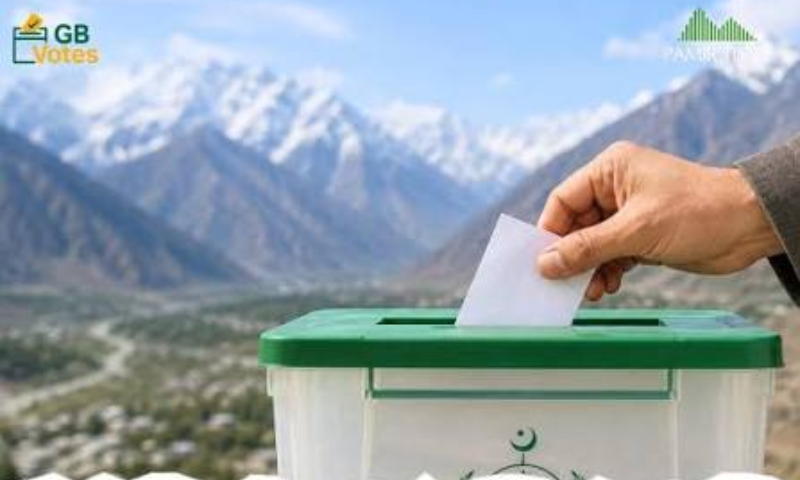
Gilgit/Skardu, June 7, 2026: Polling for elections in 24 constituencies of the Gilgit-Baltistan Assembly concluded peacefully on Sunday, with vote counting underway across the region amid tight security arrangements and reports of strong voter participation, particularly among women.
Voting commenced at 8:00am and continued uninterrupted until 5:00pm at polling stations spread across all districts of Gilgit-Baltistan.
Chief Election Commissioner Raja Shahbaz visited several polling stations during the day to review voting arrangements and monitor the electoral process. Speaking to the media after polling ended, he expressed satisfaction over the peaceful conduct of the elections and praised the performance of election staff and security personnel.
“The election process has been completed in a peaceful environment,” Raja Shahbaz said, noting that voter turnout remained encouraging, especially among female voters.
He added that the overall law and order situation remained under control throughout the day and that polling agents were consulted regarding any complaints related to the electoral process.
“I personally visited various polling stations to assess arrangements on the ground and monitor the voting process,” the Chief Election Commissioner said.
The Election Commission established 1,391 polling stations across Gilgit-Baltistan for the elections. Of these, 488 were categorized as normal, 349 as sensitive, and 551 as highly sensitive.
District-wise details show:
- Gilgit: 253 polling stations (51 normal, 48 sensitive, 154 highly sensitive)
- Ghizer: 207 polling stations (83 normal, 52 sensitive, 69 highly sensitive)
- Nagar: 85 polling stations (28 normal, 39 sensitive, 18 highly sensitive)
- Hunza: 88 polling stations (33 normal, 31 sensitive, 24 highly sensitive)
- Skardu: 208 polling stations (88 normal, 51 sensitive, 69 highly sensitive)
- Shigar: 71 polling stations (31 normal, 23 sensitive, 17 highly sensitive)
- Kharmang: 43 polling stations (12 normal, 10 sensitive, 21 highly sensitive)
- Ghanche: 154 polling stations (89 normal, 39 sensitive, 26 highly sensitive)
- Astore: 108 polling stations (40 normal, 34 sensitive, 34 highly sensitive)
Major parties in the contest
The elections witnessed participation from a wide range of political parties and independent candidates.
The Pakistan Peoples Party (PPP) fielded the highest number of candidates, with 23 contestants, followed by the Pakistan Muslim League-Nawaz (PML-N) with 22 candidates. Nineteen independent candidates backed by Pakistan Tehreek-e-Insaf (PTI) also entered the race.
Other parties participating in the elections include:
- Istehkam-e-Pakistan Party (IPP): 15 candidates
- Pakistan Nazriyati Party (PNP): 11 candidates
- Jamiat Ulema-e-Islam-Fazl (JUI-F): 9 candidates
- Islami Tehreek Pakistan (ITP): 9 candidates
- Majlis Wahdat-e-Muslimeen (MWM): 7 candidates
- Jamaat-e-Islami (JI): 6 candidates
- Muttahida Qaumi Movement-Pakistan (MQM-P): 6 candidates
- Awami Workers Party (AWP): 4 candidates
Tight security across the region
Authorities implemented extensive security measures to ensure a peaceful electoral process.
Personnel from the Gilgit-Baltistan Police, Gilgit-Baltistan Scouts, and contingents of Punjab Police and Sindh Police were deployed across polling stations and other sensitive locations.
Additional security arrangements were made at vulnerable polling stations, while law enforcement agencies and district administrations remained on high alert throughout polling day.
Speaking to journalists, Gilgit-Baltistan Inspector General of Police Nasir Akbar Khan said that more than 17,500 security personnel had been deployed to maintain law and order during the elections.
With polling completed peacefully, attention has now shifted to the vote-counting process, which will determine the composition of the next Gilgit-Baltistan Assembly and the political balance in the strategically important region.