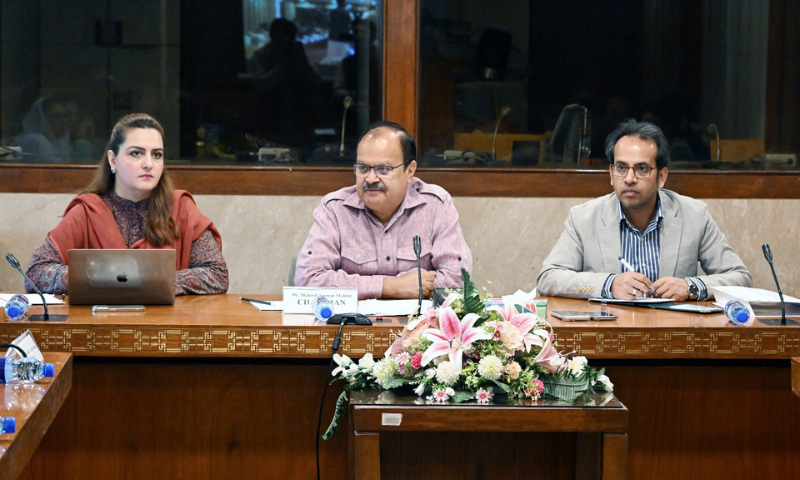
Islamabad, May 5, 2026: The National Assembly of Pakistan Standing Committee on National Health Services, Regulations and Coordination on Tuesday expressed serious concern over the rising number of HIV/AIDS cases in the country, calling for full transparency and immediate coordinated national action to curb the spread of the disease.
The committee, chaired by MNA Dr. Mahesh Kumar Malani, conducted a detailed review of Pakistan’s HIV situation and described the issue as “urgent, sensitive and requiring coordinated national action.”
According to officials from the Ministry of National Health Services, an estimated 369,000 people are currently living with HIV in Pakistan, while only around 84,000 cases have been officially registered, exposing a major gap in detection and treatment coverage.
The committee was informed that 14,000 new HIV cases were reported during 2025 alone. Although screening capacity has increased significantly — from 37,000 tests in 2020 to more than 374,000 in 2025 — lawmakers warned that higher detection rates should not be interpreted as successful disease control.
In a major disclosure, officials revealed that nearly 20,000 patients who had begun treatment at Antiretroviral Therapy (ART) centres were now considered “missing,” raising concerns regarding patient follow-up, counselling, monitoring and treatment retention.
The ministry informed lawmakers that a comprehensive national master plan was being developed to address these shortcomings.
Committee members noted that Pakistan’s overall HIV prevalence rate stood at 0.2 percent, compared to the global average of 0.5 percent. However, they warned that localized outbreaks in areas such as Taunsa, Kot Momin and parts of South Punjab reflected serious weaknesses in infection prevention and control measures, unsafe medical practices and poor regulatory enforcement.
Officials told the committee that the Walika outbreak in Karachi had been linked to the use of reusable 10cc syringes, which had not previously been banned. The ministry said all reusable syringes, including 10cc variants, would now be phased out and brought under stricter regulatory control.
Lawmakers also voiced concern over the continued availability of banned syringes in markets despite prohibitions imposed since 2021, inadequate oversight of blood banks and transfusion camps, weak public awareness campaigns and the persistent social stigma discouraging testing and treatment.
The committee further discussed cross-border health risks, noting that individuals deported from other countries often remained unscreened because host states avoided publicly reporting such cases. Officials said a new mechanism involving exit-entry data integration was being developed to ensure proper screening and monitoring before re-entry into Pakistan.
While ministry officials argued that expanded testing demonstrated progress in the national HIV programme, committee members stressed that the real measure of success would be a reduction in new infections rather than simply identifying more cases.
The committee called for the immediate nationwide rollout of auto-disable syringes, including 10cc variants, tougher enforcement against unsafe medical practices, comprehensive public awareness campaigns to combat stigma, district-wise reporting of HIV cases and outbreak investigations, and the implementation of a clear, time-bound national strategy to contain the spread of the disease.
The meeting was attended by several members of the National Assembly, including Zahra Wadood Fatemi, Farah Naz Akbar, Dr. Shazia Sobia Aslam Soomro, Dr. Shaista Khan, Dr. Nikhat Shakeel Khan and other senior parliamentarians, along with the federal health minister and senior officials from the Ministry of National Health Services, Regulations and Coordination.