Washington/Tehran/Beirut, June 4, 2026: United States President Donald Trump has claimed that Washington and Tehran are close to reaching a major agreement that could include the removal of Iran’s highly enriched uranium, while parallel diplomatic efforts are underway to preserve a fragile ceasefire between Israel and Lebanon amid continuing hostilities across the region.
In an interview with the Financial Times, President Trump said the United States would, in coordination with Iran, remove high-level enriched uranium from the country in the near future.
“We will enter at some point in the near future to remove Iran’s high-level enriched uranium from the ruins,” Trump said, adding that Tehran had agreed to the arrangement as part of ongoing negotiations.
The US president suggested that a broader breakthrough in talks could occur within days, telling reporters at the White House that progress could come “over the weekend.”
Trump criticizes congressional effort to limit war powers
Trump also sharply criticized a vote in the US House of Representatives aimed at restricting his authority to continue military operations against Iran without congressional approval.
The Republican-led House approved a war powers resolution by a vote of 215-208, directing the president to withdraw US forces from Iran unless Congress formally authorizes military action.
Calling the move “meaningless” and “unpatriotic,” Trump argued that lawmakers were undermining sensitive negotiations with Tehran.
The measure remains largely symbolic unless approved by the Senate and signed into law, but it highlights growing concern among both Republicans and Democrats over the administration’s handling of the conflict, now entering its fourth month.
Iran calls for unity, warns against external pressure
Meanwhile, Iranian Supreme Leader Mojtaba Khamenei urged national unity, claiming Iran’s adversaries had failed militarily and were now attempting to weaken the country through psychological and political pressure.
In a message marking the anniversary of the death of Ruhollah Khomeini, Khamenei said Iran’s enemies were seeking to create fear, pessimism, and internal divisions after suffering setbacks on the battlefield.
“The enemy, having failed militarily and experienced deep humiliation, is now focused on sowing doubt, despair, fear, and division,” he said.
Khamenei accused the United States of supporting what he described as an oppressive regional order and reiterated Tehran’s determination to resist external pressure.
Separately, Iranian Parliament Speaker Mohammad Bagher Ghalibaf warned that the era of “cost-free threats” against Iran had ended.
“Any aggression will be met with a decisive, regretful, and proportionate response,” he said.
Israel and Lebanon agree on new ceasefire framework
Amid mounting international pressure, Israel and Lebanon announced progress toward strengthening their fragile ceasefire following a fourth round of US-mediated negotiations in Washington.
According to a joint statement, both sides agreed to establish “pilot zones” in southern Lebanon where the Lebanese Armed Forces would exercise exclusive territorial control, excluding all non-state armed groups.
The agreement calls for a complete cessation of fire by Hezbollah and the withdrawal of its operatives from areas south of the Litani River.
Negotiators agreed to resume political and security discussions during the week of June 22 with the objective of reaching a broader peace and security arrangement.
The statement also emphasized that both countries have “no hostile intent toward one another” and committed to preventing the re-emergence of armed non-state groups in the border region.
Lebanon calls agreement ‘last opportunity’
Lebanese President Joseph Aoun described the negotiations as difficult but crucial.
He revealed that talks had nearly collapsed due to disagreements with Israel before intervention by US Secretary of State Marco Rubio helped revive the process.
“This is a last opportunity,” Aoun warned, adding that implementation could begin within 24 hours once all parties formally approve the agreement and provide guarantees.
During a separate meeting with French envoy Jean-Yves Le Drian, Aoun stressed the need to avoid giving Israel any justification for maintaining a military presence in southern Lebanon.
Violence continues despite diplomatic progress
Despite renewed diplomatic efforts, violence persisted across Lebanon.
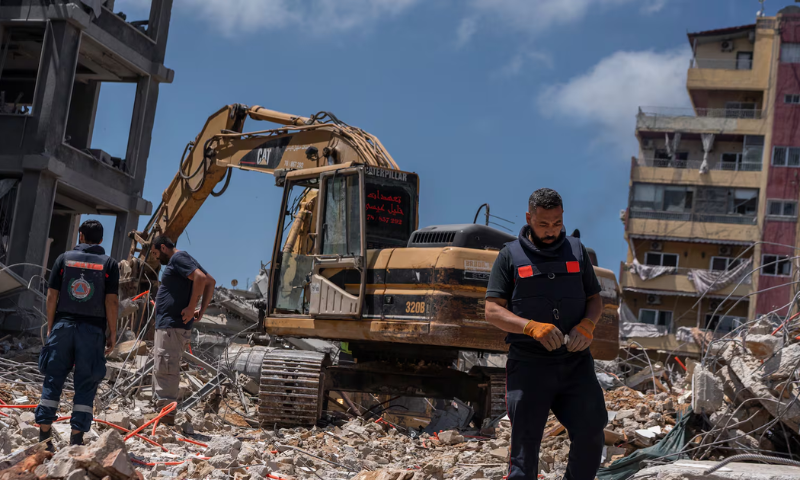
According to Lebanese authorities, multiple Israeli airstrikes targeted areas in the Bekaa Valley and southern Lebanon, including Sohmor, Haddatha, Tibnin, Haris, Kfar, Harin, and other towns.
Lebanon’s Health Ministry reported that at least four people, including a paramedic, were killed in separate Israeli attacks on Thursday, while several others were injured.
Israeli military operations have continued despite a ceasefire that took effect in April and was subsequently extended into July.
Lebanese officials say Israeli military actions since March have killed more than 3,500 people and injured over 10,000.
Hezbollah and Israel trade accusations
The conflict also saw renewed exchanges between Israel and Hezbollah.
Israeli military officials reported intercepting projectiles and a hostile aircraft launched from Lebanon, while Hezbollah said it had carried out rocket attacks against Israeli military positions in response to alleged Israeli ceasefire violations.
Israeli media also reported that a Hezbollah drone struck the vehicle of Major General Rafi Milo in southern Lebanon shortly after he exited the vehicle. No casualties were reported.
Israeli Defence Minister Israel Katz welcomed the US-brokered agreement, calling it a major achievement and emphasizing that Israel retained the right to respond militarily to any future attacks.
However, divisions emerged within Israel’s political leadership.
Former defence chief and opposition leader Benny Gantz cautiously supported the agreement but insisted Israeli forces should remain deployed until it is fully implemented.
Meanwhile, National Security Minister Itamar Ben-Gvir condemned the deal as a “serious mistake,” arguing that Hezbollah had not been sufficiently weakened and could emerge stronger in the future.
Regional stability hinges on parallel negotiations
The evolving negotiations with Iran and the efforts to stabilize the Israel-Lebanon front have become increasingly interconnected.
Iran has reportedly linked broader understandings with Washington to an end to Israeli military operations in Lebanon, while the United States is attempting to separate the two tracks in order to secure progress on issues including nuclear restrictions and maritime security.
With diplomatic activity intensifying and ceasefire arrangements under discussion, regional stakeholders are closely watching whether the coming days will produce a breakthrough capable of reducing tensions across the Middle East or whether continued military clashes will undermine the fragile progress achieved so far.